Adam Mactavish of Cyril Sweett provides a brief review of the incentive schemes for domestic renewables
A few years ago only the most dedicated developers (or those with tough planning requirements to meet) contemplated the use of renewable energy in new housing, while only the greenest of homeowners would consider retrofitting them into their properties. The cost, hassle and risks associated with the technologies were just too high.
A raft of new incentive schemes is rapidly changing attitudes. In fact, demand has been so high, with nearly 200MW (or 150 hectares) of large scale “solar farms” in the planning system, that the government has reduced its support for larger scale solar electric (PV) systems (those above 50kWp). Uptake of PV in the domestic sector has been broadly in line with expectations with about 15,000 small (less than 4kW) registered installations at the end of last year.
The same but different
Two incentive schemes are relevant to the domestic sector: feed-in tariffs (FIT) that support the generation of renewable electricity and the Renewable Heat Incentive (RHI), which focuses on technologies that generate heat. The structure of the schemes is similar, although the funding roots differ, with FITs paid for through utility bills and RHI money coming from government budgets.
From the domestic perspective, the key difference between the schemes is that while FITs are already available you will need to wait until 2012 to be able to claim RHI monies for domestic properties. This is because the RHI is being launched in two phases, the first of which, from 2011, only focuses on larger scale heat installations. In the second phase, from 2012, domestic scale installations will also be eligible for payments. The start of this second phase will coincide with the launch of the Green Deal, meaning that homeowners will be able to undertake both energy efficiency measures and install renewable technologies in a co-ordinated way.
For both schemes, any compliant technologies installed after 15 July 2009 will be eligible for payments, but payments under the RHI will not begin until 2012.
Together, FITs and the RHI provide support for most of the major forms of domestic renewable energy including PV, wind, solar water heating, biomass and ground source heat pumps. One notable omission is the air source heat pump. However, the government has stated it intends to introduce support for this technology for domestic property in the “second phase” of the RHI in 2012.
Some support for the domestic sector is included in the first phase of the RHI. This will take the form of Renewable Heat Premium Payments from a total fund of £15m. The payments will help subsidise the costs of installation in return for information from the households on their experience of using the technology. Details of these payments will be set out in May 2011 with the first payments made in July.
What are they worth?
The support offered by FIT and RHI varies significantly between technology types. The tariffs for typical domestic installations are shown in the table below.
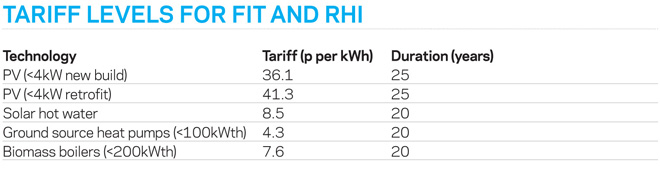
Tariffs for the technologies supported by the RHI are set for larger scale use. This is justified on the basis that larger installations will offer the most cost-effective means of generating renewable heat. It is not clear whether additional domestic-scale tariffs will be introduced before the second phase.
Assessing whether these incentives make renewables a sound investment involves consideration of several factors:
Size
For heating technologies, the appropriate system size will vary according to home type, size and energy efficiency level.
For power technologies the system size will be limited by the extent of roof area.
Installation costs
The domestic renewables sector is establishing itself in the UK. However, costs still vary significantly for the same technologies. Careful assessment of different providers and delivery options is important to getting the right level of cost and risk.
Technologies and installers need to be Micro Certification Scheme-approved.
Allowance must be made for the full range of cost items including, for example, fuel storage for biomass and scaffolding and connection costs (for solar hot water or PV).
For retrofit of technologies into existing homes it is important to consider access and integration of the incoming technology with existing systems. For example, a heat pump system will not work well in a poorly insulated property with radiators.
Running costs
All renewable technologies will require servicing and replacement of components. For “non-essential” technologies such as solar hot water and PV the system must remain operational for tariff payments to continue.
Biomass and heat pump systems will require fuels and this must be factored into any assessment. It is likely that the costs of electricity will continue to rise in the future and probably at a faster rate than gas prices.
Tariff levels
Tariff levels are fixed at the year of installation but are subject to inflation.
Tariff levels are subject to periodic reviews and, in the case of FITs, planned degression - reductions in tariff levels to compensate for predicted reductions in technology costs.
Export income and avoided energy costs
A percentage of the power generated by PV systems will be exported to the grid. This is assumed to be 50%. However, in some cases, for example where nobody is at home during the day, the export percentage may be much higher. All power exported to the grid can be sold at 3p per kWh.
Use of energy from PV or solar hot water within the home will reduce the requirement for fuel or power from the grid. This avoided energy cost can be significant, particularly for properties that are off gas where the heating is delivered using oil or electricity.
Warranty
Many technologies will be supplied with reasonable warranties (for example, 25 years for PV panels). However, it is important to consider the organisation providing the warranty and the fallback position should the organisation fail.
Warranties for watertightness or other associated impacts must also be considered. The NHBC has introduced guidance on the criteria they will consider when assessing whether they will provide a warranty for homes with renewable technologies.
The table attached summarises costs, benefits and returns offered by different systems in a typical new (Part L 2010) end of terrace house (about 75m2). Analysis is based on survey of technology costs by Cyril Sweett for the Zero Carbon Hub.
Conclusion
It is clear that for housing the FIT provides a more valuable incentive than the RHI, partly because the RHI tariff levels are set for maximum system sizes that are larger than would be used in homes. A further factor reducing the cost effectiveness of the RHI in new homes is their low heat demand compared with existing housing and industrial uses. While incentives for using PV remain strong, RHI tariffs for domestic scale technologies will need to be higher if they are to prompt many installations.
As the second phase of the scheme will coincide with the Green Deal we should hope that the opportunity to support investment in energy efficiency and low-carbon heat is maximised.
From building.co.uk

