19 June 2012
Tuesday 19 June 2012
BlueGen units to be used in Virtual Power Plant Project in The Netherlands
Ceramic Fuel Cells Limited (AIM / ASX: CFU) - a leading developer of high efficiency and low emission electricity generation products for homes and other buildings - is pleased to announce a project in The Netherlands to create a Virtual Power Plant using Ceramic Fuel Cells' BlueGen gas-to-electricity generators.
BlueGen units are planned to be installed with customers across the Netherlands to create a new community of distributed energy producers, connected through the internet and operated as a Virtual Power Plant.
Ceramic Fuel Cells is supporting its distribution partner BlueGeneration that is working on the project with Liander and IBM. This team will start designing a platform on which the Virtual Power Plant can run. During the design phase BlueGeneration, Liander and IBM will design the technical requirements and define the use cases for the platform.
Liander is a Dutch regional network operator, distributing electricity to 3.0 million customers and gas to 2.3 million customers in a large part of the Netherlands. IBM will provide the necessary system integration to control the BlueGen units remotely. IBM's extensive experience in the field of Smart Grids enables the collaboration to implement and scale up the platform.
The project partners have entered the first phase of the project, with three BlueGen units installed with energy consultants' KIWA Gastec for testing at their facilities in Apeldoorn. The aim is to test the compatibility with the designed systems and to have a closed and regulated environment for the first tests. During this test phase of approximately one year the influence of extreme modulation cycles will also be examined as well as the impact for the grid operator.
The tests at Kiwa began in April 2012. The partners are currently developing the Virtual Power Plant design, and intend to scale up the project in the second half of this calendar year and into 2013.
A Virtual Power Plant is a cluster of distributed electricity generation units, controlled and operated by a central entity using integrated software systems. A Virtual Power Plant allows power generation to be modulated up or down to meet peak loads and balance intermittent power from wind or solar, with higher efficiency and more flexibility than large centralised power stations.
By incorporating the Virtual Power Plant in Lianders' Smart Grid, Liander will be able to locally balance the demand and supply of electricity. The end customers will benefit from lower energy costs.
Ceramic Fuel Cells' Managing Director Brendan Dow said:
"Clearly, energy generation systems of the future will involve projects like this. We are delighted that companies like Liander and IBM, as well as our partner BlueGeneration, have seen the benefit of pursuing this virtual power plant, which has our highly-efficient BlueGen units as its cornerstone."
Peter van der Sluijs, Liander said:
"In the future we expect more and more customers to produce their own power and coordinate their energy use locally. Virtual power plants are a big step towards more sustainable energy system where local generation has a critical role."
Matthijs Guichelaar of BlueGeneration said:
"This project is the example of how future flows of energy and IT can provide a solid base for renewable and distributed generation. The flexibility of the BlueGen and its high efficient electricity production makes it a very suitable component for the new Smart Grid. When the usage of biogas becomes available, the system will also be carbon neutral. This enables the agricultural sector to efficiently convert their biogas into electricity."
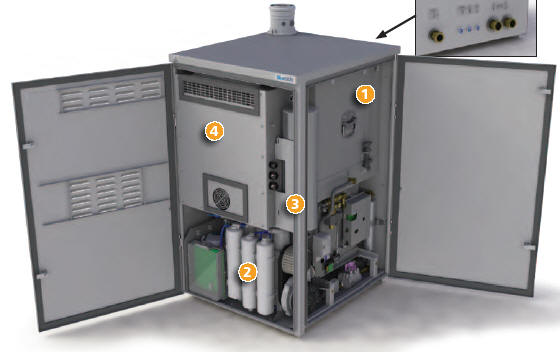
The BlueGen product uses ceramic fuel cells to turn natural gas into electricity and heat for hot water, with each unit capable of producing more than three times the electricity needed to power the average Dutch home. (In The Netherlands an average home consumes an estimated 3,500 kilowatt hours of electricity per year.)
Surplus electricity can be sold back to the grid or used in supplementary applications such as charging electric cars, as well as having the additional benefit of providing heat for domestic hot water use. BlueGen units generate electricity with the highest electrical efficiency of any small scale generating technology in the world, reducing energy bills and cutting carbon emissions.
In the Netherlands customers are allowed to export electricity to the grid when they have a surplus and take it back from the grid later when they need it without being charged with energy tax on this energy. This tax-free interchange has a maximum of 5000 kWh per year.
According to a report from US analyst firm Pike Research, virtual power plant capacity will increase by 65 percent between 2011 and 2017, rising from 55.6 gigawatts (GW) to 91.7 GW worldwide during that period. In a more aggressive forecast scenario, the capacity growth is up to 126 percent during the same period.
Releasing the report in November 2011, Pike Research senior analyst Peter Asmus said: "Virtual power plants essentially represent an 'Internet of Energy', tapping existing grid networks to tailor electricity supply and demand services for a customer. They maximize value for both the end user and distribution utility, primarily through software innovations."(1)
ENDS
