Fuel cell manufacturer, Ceres Power Holdings plc has commenced commercial field trials of its wall‐mounted Combined Heat and Power (CHP) boiler in occupied homes.
Following receipt of European type approval, an operating fuel cell CHP product generating heat and power has now been installed in the family home of a British Gas customer in South East England. The field trials programme will continue throughout 2011 and into 2012 with Ceres' CHP products being deployed in a wide range of homes across the UK. In addition, there is an extensive on‐going testing programme of CHP products and components at the Ceres' test facilities.
The first wave of CHP products is being installed in consumers' homes during the first quarter of 2011, with the second wave of products incorporating valuable in‐field experience to follow six months later. The final wave of at least 150 field trial CHP products will take place in 2012 to test the Company's ability to scale‐up for initial product sales and volume launch with British Gas.
The Ceres Power fuel cell CHP product operates on mains natural gas and can generate all of the heating and hot water and the majority of the electricity needs of a typical UK home.
The CHP boilers for the field trials are being manufactured using volume‐capable processes, with the fuel cells at the heart of the product being produced at the Ceres factory in Horsham, whilst CHP boiler assembly is taking place in Holland.
Peter Bance, Chief Executive Officer of Ceres Power, says "We have made enormous progress in the development of our product over the past few months and the start of commercial field trials is a major milestone in Ceres Power's development. I am delighted that our unique wall‐ mounted fuel cell CHP product is now being installed in consumers' homes and look forward to selling the product in conjunction with British Gas."
The field trials are being conducted in partnership with British Gas. Under the contract with Ceres Power, British Gas is paying £5 million to the Company in staged milestone payments and has also placed a forward order to purchase in aggregate a minimum of 37,500 CHP products on an escalating basis. Ceres Power will give an update on its British Gas residential CHP programme at the Company's Interim Results to be presented next month.
Showing posts with label boiler. Show all posts
Showing posts with label boiler. Show all posts
Monday, 21 February 2011

Friday, 18 February 2011
Ceramic Fuel Cell Introduce The BlueGen Fuel Cell micro CHP unit
Currently Not Available In The UK until 2012
BlueGen is the latest breakthrough in small scale electricity generation - a modular style fuel cell generator that can be configured to suit a range of different markets and installations. For markets that require an alternative product approach to fully-integrated 'European style' systems, such as Japan, Northern America and Australia - BlueGen™ bridges that gap.


The future of electricity generation will be using a Distributed Generation network, where electricity can be generated and consumed at the point of use. Distributed Generation networks can address the concerns of; increasing electricity demand, limitations of traditional power generation, efficiency losses through transmission & distribution lines and significant infrastructure investment. There is a need today, and in the future, for secure and highly efficient generation of electricity with significantly lower greenhouse gas emissions. BlueGen™ is the latest in Solid Oxide Fuel Cell (SOFC) technology to deliver highly efficient electricity.
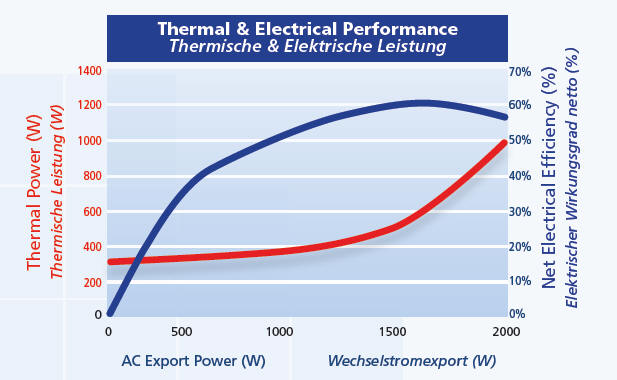
BlueGen™ utilises the latest Gennex™ fuel cell module that offers the highest levels electrical efficiency in the world – 60% net electrical efficiency. This means BlueGen™ produces more electricity from the same amount of fuel compared to traditional small scale electric generators.

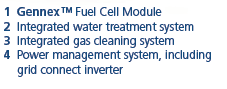
BlueGen™ is fitted with an integrated heat exchanger to recover the heat from the fuel cell module. A separate water tank (not supplied) can be connected to the unit to increase the total system efficiency.
BlueGen™ can be installed as:
SSElectric Generator system; no heat recovery = power only
SSCo-Generation Ssystem; Swith Sheat Srecovery S= power + heat
Because of the high level of electric efficiency, BlueGen™ produces much less heat than other electric generators. Less heat means the unit can operate for longer, which in turn means, more high-efficiency electricity that helps reduce CO2

Functionality
The BlueGen™ unit can operate as a stand-alone generator or be remotely controlled. The output power level can be adjusted to suit a number of different electricity production requirements; from ‘constant base-load power’ generation to pre-set ‘peak shaving’ generation profiles. The BlueGen™ unit has a number of different operating modes:
Heat-up
• Fully automatic using mains power (grid Sindependent Sstart-up Snot Spossible)
Self sustain
• Unit is producing electricity, but with zero power export (e.g. in event of extended grid fault)
Power production
• Unit is exporting electricity; power output can be modulated from 0% to 100%
Cool down
• Using mains power (approx. 36 to 72 hours for safe cool down)
Specifications Spezifikationen
Model Number: BlueGen Modellnummer: BlueGen
Performance Leistung
Electric Output: 0 to 2,000 W
Power output modulation from 0 % to 100 %
Elektrische Leistung: 0 bis 2.000 W
Stromausgangsregulierung von 0 % bis 100 %
Max. Electrical Efficiency: 60 % at 1,500 W output
(Net AC export LHV)
Max. elektr. Wirkungsgrad: 60 % bei 1.500 W Leistung
(Wechselstromexport netto; unterer Heizwert)
Note: Thermal output and water recovery only possible with heat recovery system connected Anmerkung: Thermische Leistung und Wasserrückgewinnung ist nur mit angeschlossenem Wärmerückgewinnungssystem möglich
Thermal Output: Approx. 300 W to 1,000 W
Depending on electric power output and heat recovery water temperature (exhaust gas cooled to 30 °C)
Thermische Leistung: ca. 300 W bis 1.000 W
Abhängig von Stromleistung und Rücklaufttemperatur
(Abgas auf 30° gekühlt)
Total System Efficiency: Up to 85 %
(depending on heat and condensate recovered)
Gesamtsystemwirkungsgrad: Bis zu 85 %
(abhängig von der zurückgewonnenen Wärme und Kondensat)
Inputs Eingaben
Electrical: 230V ±10% 50Hz
Single Phase AC parallel grid connected
Elektrisch: 230V ±10% 50Hz
Einphasenwechselstrom parallel zum Stromnetz geschaltet
Natural Gas: For start-up & operation
Supply pressure 0.9 to 2 kPa
(integrated gas desulphurisation)
Erdgas: Für Inbetriebnahme & Betrieb:
Versorgungsdruck 0.9 bis 2 kPa
(eingebaute Gasentschwefelung)
Water: For internal steam reforming:
Supply pressure min. 100 to 600 kPa
(integrated water treatment system)
Wasser: Für interne Dampfreformierung
Versorgungsdruck min. 100 bis 600 kPa
(eingebaute Wasseraufbereitung)
Consumption (at maximum output) Verbrauch (bei maximaler Leistung)
Natural Gas: 12.6 MJ/hr (12,000 BTU/hr)
Actual gas volume dependant on composition of natural gas
Erdgas: 12.6 MJ/h. (12,000 BTU/h.)
Tatsächliches Gasvolumen abhängig von der Zusammensetzung des Erdgases
Water: 0.0 ℓ/hr - 1.67 ℓ/hr
Water consumption dependant on:
i) if heat recovery connected
ii) amount of condensate recovered from flue gas
Wasser: 0.0 ℓ/h. - 1.67 ℓ/h.
Wasserverbrauch abhängig von:
i) angeschlossene Wärmerückgewinnung
ii) Menge des aus dem Abgas zurückgewonnenen Kondensats
Outputs Ausgaben
Net AC export: 0 W – 2,000 W
Single Phase parallel grid connected: 230V ±10% 50Hz
Wechselstromexport netto: 0 W – 2,000 W
Einphase parallel am Stromnetz angeschlossen: 230V ±10% 50Hz
CO2Emissions: 340 g/kWh
Flue gas emissions consist of CO2and water vapour, virtually no NOx or SOx emissions
CO2Emissionen: 340 g/kWh
Abgasemision besteht aus CO2und Wasserdampf, nahezu keine NOx oder SOx Emissionen
Flue Gas Temperature: Max 200 °C
Maximum if heat recovery system not connected
Abgastemperatur: Max 200 °C
Höchstwert, falls Wärmerückgewinnungssystem nicht angeschlossen ist
Useable Water: Max 1.1 L/hr
From water treatment system if heat recovery system not connected
Verwendbares Wasser: Max 1.1 L/h.
Vom Wasseraufbereitungssystem, falls Wärmerückgewinnungssystem nicht angeschlossen ist
Noise level: < 45 dBa Lärmpegel: < 45 dBa
Operating Conditions & Other Betriebsbedingungen & Sonstiges
Ambient Temperature: +1 °C - +45 °C Umgebungstemperatur: +1 °C - +45 °C
Inlet Air Temperature: -20 °C - +45 °C Luftzufuhrtemperatur: -20 °C - +45 °C
Location: Indoors - excluding living zones
Outdoors - protected from the elements and above freezing temperature
Standort: Im Haus – Wohnbereiche ausgenommen
Im Freien – geschützt vor den Elementen und über dem
Gefrierpunkt
Start-up Time: 25 Hours Anlaufzeit: 25 Stunden
Minor Maintenance Approx 12 months
Air filters (depending on installed location)
Water filters (depending on input water quality)
Intervall Kleinwartung: ca. 12 Monate
Luftfilter (abhängig vom Installationsstandort)
Wasserfilter (abhängig von der eingebrachten Wasserqualität
Major Maintenance Interval: Greater than 12 months
Desulphuriser (subject to gas composition)
Air filters (depending on installed location)
Water filters (depending on input water quality)
Intervall Hauptwartung: Größer als 12 Monate
Entschwefler (abhängig von der Gaszusammensetzung)
Luftfilter (abhängig vom Standort)
Wasserfilter (abhänig von der einbringenden Wasserqualität)
Approx. Mass: < 200 kg Gewicht ca.: < 200 kg
Connections Verbindungen
Fuel: ½" BSP female Brennstoff: ½" BSP-Innengewinde
Water
Supply: ¼" quick connect ‘John Guest’ fitting
Hot water: 2 x ¾" BSP female
Drain: 2 x ¼" quick connect ‘John Guest’ fittings
Wasser
Versorgung: ¼"Anschlussverbindung "John Guest"
Heißwasser: 2 x ¾" BSP-Innengewinde
Abfluss: 2 x ¼" Schnellanschlussverbindung "John Guest"
Electricity: Hardwired via junction box on external casing Elektrizität: Festverdrahtet via Anschluss-kasten an externem Gehäuse
Flue: Balanced flue with standard concentric flue
100/60 mm diameter
Rauchabzug: Abgassystem mit konzentrischem Standard-abgassystem
100/60 mm Durchmesser
Communication: Connection via standard Ethernet port Datenübertragung: Verbindung via Standard Ethernetport
ORIONAIRSALES: Buy Air Source Heat Pumps for home use.
BlueGen is the latest breakthrough in small scale electricity generation - a modular style fuel cell generator that can be configured to suit a range of different markets and installations. For markets that require an alternative product approach to fully-integrated 'European style' systems, such as Japan, Northern America and Australia - BlueGen™ bridges that gap.
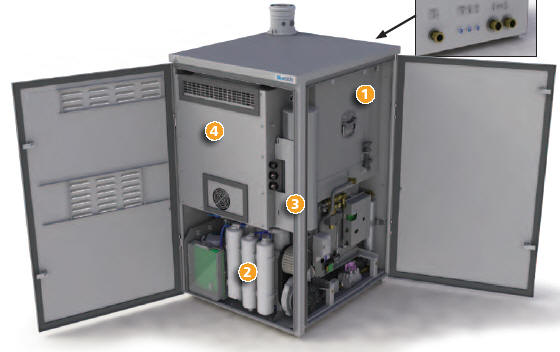
The future of electricity generation will be using a Distributed Generation network, where electricity can be generated and consumed at the point of use. Distributed Generation networks can address the concerns of; increasing electricity demand, limitations of traditional power generation, efficiency losses through transmission & distribution lines and significant infrastructure investment. There is a need today, and in the future, for secure and highly efficient generation of electricity with significantly lower greenhouse gas emissions. BlueGen™ is the latest in Solid Oxide Fuel Cell (SOFC) technology to deliver highly efficient electricity.
BlueGen™ utilises the latest Gennex™ fuel cell module that offers the highest levels electrical efficiency in the world – 60% net electrical efficiency. This means BlueGen™ produces more electricity from the same amount of fuel compared to traditional small scale electric generators.
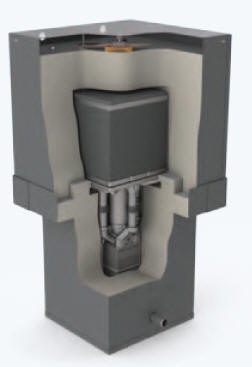
BlueGen™ is fitted with an integrated heat exchanger to recover the heat from the fuel cell module. A separate water tank (not supplied) can be connected to the unit to increase the total system efficiency.
BlueGen™ can be installed as:
SSElectric Generator system; no heat recovery = power only
SSCo-Generation Ssystem; Swith Sheat Srecovery S= power + heat
Because of the high level of electric efficiency, BlueGen™ produces much less heat than other electric generators. Less heat means the unit can operate for longer, which in turn means, more high-efficiency electricity that helps reduce CO2
Functionality
The BlueGen™ unit can operate as a stand-alone generator or be remotely controlled. The output power level can be adjusted to suit a number of different electricity production requirements; from ‘constant base-load power’ generation to pre-set ‘peak shaving’ generation profiles. The BlueGen™ unit has a number of different operating modes:
Heat-up
• Fully automatic using mains power (grid Sindependent Sstart-up Snot Spossible)
Self sustain
• Unit is producing electricity, but with zero power export (e.g. in event of extended grid fault)
Power production
• Unit is exporting electricity; power output can be modulated from 0% to 100%
Cool down
• Using mains power (approx. 36 to 72 hours for safe cool down)
Specifications Spezifikationen
Model Number: BlueGen Modellnummer: BlueGen
Performance Leistung
Electric Output: 0 to 2,000 W
Power output modulation from 0 % to 100 %
Elektrische Leistung: 0 bis 2.000 W
Stromausgangsregulierung von 0 % bis 100 %
Max. Electrical Efficiency: 60 % at 1,500 W output
(Net AC export LHV)
Max. elektr. Wirkungsgrad: 60 % bei 1.500 W Leistung
(Wechselstromexport netto; unterer Heizwert)
Note: Thermal output and water recovery only possible with heat recovery system connected Anmerkung: Thermische Leistung und Wasserrückgewinnung ist nur mit angeschlossenem Wärmerückgewinnungssystem möglich
Thermal Output: Approx. 300 W to 1,000 W
Depending on electric power output and heat recovery water temperature (exhaust gas cooled to 30 °C)
Thermische Leistung: ca. 300 W bis 1.000 W
Abhängig von Stromleistung und Rücklaufttemperatur
(Abgas auf 30° gekühlt)
Total System Efficiency: Up to 85 %
(depending on heat and condensate recovered)
Gesamtsystemwirkungsgrad: Bis zu 85 %
(abhängig von der zurückgewonnenen Wärme und Kondensat)
Inputs Eingaben
Electrical: 230V ±10% 50Hz
Single Phase AC parallel grid connected
Elektrisch: 230V ±10% 50Hz
Einphasenwechselstrom parallel zum Stromnetz geschaltet
Natural Gas: For start-up & operation
Supply pressure 0.9 to 2 kPa
(integrated gas desulphurisation)
Erdgas: Für Inbetriebnahme & Betrieb:
Versorgungsdruck 0.9 bis 2 kPa
(eingebaute Gasentschwefelung)
Water: For internal steam reforming:
Supply pressure min. 100 to 600 kPa
(integrated water treatment system)
Wasser: Für interne Dampfreformierung
Versorgungsdruck min. 100 bis 600 kPa
(eingebaute Wasseraufbereitung)
Consumption (at maximum output) Verbrauch (bei maximaler Leistung)
Natural Gas: 12.6 MJ/hr (12,000 BTU/hr)
Actual gas volume dependant on composition of natural gas
Erdgas: 12.6 MJ/h. (12,000 BTU/h.)
Tatsächliches Gasvolumen abhängig von der Zusammensetzung des Erdgases
Water: 0.0 ℓ/hr - 1.67 ℓ/hr
Water consumption dependant on:
i) if heat recovery connected
ii) amount of condensate recovered from flue gas
Wasser: 0.0 ℓ/h. - 1.67 ℓ/h.
Wasserverbrauch abhängig von:
i) angeschlossene Wärmerückgewinnung
ii) Menge des aus dem Abgas zurückgewonnenen Kondensats
Outputs Ausgaben
Net AC export: 0 W – 2,000 W
Single Phase parallel grid connected: 230V ±10% 50Hz
Wechselstromexport netto: 0 W – 2,000 W
Einphase parallel am Stromnetz angeschlossen: 230V ±10% 50Hz
CO2Emissions: 340 g/kWh
Flue gas emissions consist of CO2and water vapour, virtually no NOx or SOx emissions
CO2Emissionen: 340 g/kWh
Abgasemision besteht aus CO2und Wasserdampf, nahezu keine NOx oder SOx Emissionen
Flue Gas Temperature: Max 200 °C
Maximum if heat recovery system not connected
Abgastemperatur: Max 200 °C
Höchstwert, falls Wärmerückgewinnungssystem nicht angeschlossen ist
Useable Water: Max 1.1 L/hr
From water treatment system if heat recovery system not connected
Verwendbares Wasser: Max 1.1 L/h.
Vom Wasseraufbereitungssystem, falls Wärmerückgewinnungssystem nicht angeschlossen ist
Noise level: < 45 dBa Lärmpegel: < 45 dBa
Operating Conditions & Other Betriebsbedingungen & Sonstiges
Ambient Temperature: +1 °C - +45 °C Umgebungstemperatur: +1 °C - +45 °C
Inlet Air Temperature: -20 °C - +45 °C Luftzufuhrtemperatur: -20 °C - +45 °C
Location: Indoors - excluding living zones
Outdoors - protected from the elements and above freezing temperature
Standort: Im Haus – Wohnbereiche ausgenommen
Im Freien – geschützt vor den Elementen und über dem
Gefrierpunkt
Start-up Time: 25 Hours Anlaufzeit: 25 Stunden
Minor Maintenance Approx 12 months
Air filters (depending on installed location)
Water filters (depending on input water quality)
Intervall Kleinwartung: ca. 12 Monate
Luftfilter (abhängig vom Installationsstandort)
Wasserfilter (abhängig von der eingebrachten Wasserqualität
Major Maintenance Interval: Greater than 12 months
Desulphuriser (subject to gas composition)
Air filters (depending on installed location)
Water filters (depending on input water quality)
Intervall Hauptwartung: Größer als 12 Monate
Entschwefler (abhängig von der Gaszusammensetzung)
Luftfilter (abhängig vom Standort)
Wasserfilter (abhänig von der einbringenden Wasserqualität)
Approx. Mass: < 200 kg Gewicht ca.: < 200 kg
Connections Verbindungen
Fuel: ½" BSP female Brennstoff: ½" BSP-Innengewinde
Water
Supply: ¼" quick connect ‘John Guest’ fitting
Hot water: 2 x ¾" BSP female
Drain: 2 x ¼" quick connect ‘John Guest’ fittings
Wasser
Versorgung: ¼"Anschlussverbindung "John Guest"
Heißwasser: 2 x ¾" BSP-Innengewinde
Abfluss: 2 x ¼" Schnellanschlussverbindung "John Guest"
Electricity: Hardwired via junction box on external casing Elektrizität: Festverdrahtet via Anschluss-kasten an externem Gehäuse
Flue: Balanced flue with standard concentric flue
100/60 mm diameter
Rauchabzug: Abgassystem mit konzentrischem Standard-abgassystem
100/60 mm Durchmesser
Communication: Connection via standard Ethernet port Datenübertragung: Verbindung via Standard Ethernetport
ORIONAIRSALES: Buy Air Source Heat Pumps for home use.
Ceramic Fuel Cells Limited Cashflow Report quarter end 31st Dec 2010
RNS Number : 9315Z
Ceramic Fuel Cells Limited
24 January 2011
24 January 2011
Ceramic Fuel Cells Limited
Quarterly Cashflow Report and Trading Update
Ceramic Fuel Cells Limited (AIM / ASX: CFU) a leading developer of high efficiency and low emission power products for homes, today released its quarterly cashflow report for the period ended 31 December 2010.
The cashflow report is available at www.cfcl.com.au.
Highlights
-- Conditional order for up to 200 integrated mCHP products - total contract value of up to 4.9 million Euros (AUD 6.6 million) over two years
-- Further sales of BlueGen units - cumulative orders for 62 BlueGen units in many large global markets
-- First BlueGen sale in Italy
-- Hills Industries Limited appointed as BlueGen distributor and national service and support partner in Australia
-- Progress towards product certification for UK feed-in tariff
-- BlueGen assembly transferred from Melbourne to Germany and operational from January 2011
-- Supply agreement with HC Starck secures long term volume supply of fuel cell components at agreed prices
-- Powder sale contract - CFCL's UK plant to supply ceramic powder to HC Starck
Operational Review
Order for 200 integrated products
In December the Company received a conditional order for up to 200 integrated power and heat generators from German energy service provider EWE. This is the largest order the Company has received, with total revenue of up to EUR 4.9 million over two years.
The integrated units use Ceramic Fuel Cells' patented technology to convert natural gas into electricity, hot water and space heating, with the world's highest level of electrical efficiency in small scale generators.
Ceramic Fuel Cells will supply the core Gennex fuel cell module and related components. Ceramic Fuel Cells and its local manufacturing partner, Gebruder Bruns Heiztechnik GmbH, will integrate the fuel cell module with a boiler into an integrated power and heating product for supply to EWE. EWE will then install the units in homes in the Lower Saxony region in northern Germany.
EWE is one of the largest utilities in Germany, with 6,400 staff and revenues of EUR 5.8 billion. Based in Northern Germany, EWE also has operations in other German states as well as Poland and Turkey.
The order is conditional on EWE receiving partial funding under the German government's national hydrogen and fuel cell technology innovation program. This Government program is providing EUR 700 million between 2008 and 2018. EWE has submitted a formal funding application and a positive decision is expected in early 2011.
Subject to EWE obtaining Government funding and to the units meeting agreed performance targets, EWE will order 70 units for delivery in 2011 and 130 units for delivery in 2012. The performance targets, unit prices and the rates for ongoing service and support have been agreed in a contract signed by EWE and Ceramic Fuel Cells.
This is a significant follow-on order from EWE, the Company's longest standing utility customer. The Company is confident that the German government will support the project and we look to updating shareholders in due course.
Apart from Germany, during the December quarter the Company also continued to operate integrated power and heating units with its appliance partners in the United Kingdom and France.
BlueGen sales
Apart from the integrated product, the Company has also developed a modular power and heat generator called BlueGen, to provide low emission power plus heat for hot water. One BlueGen can provide about double the electricity the average home needs - excess power can be exported to the grid - plus hot water for an average family's needs.
Like the integrated product, BlueGen uses the Company's Gennex fuel cell module to achieve electrical efficiency of 60 percent - far higher than any other small scale generator. The Company believes this very high electrical efficiency will deliver significant value to BlueGen customers, and will create a significant competitive advantage in the fast growing global market for small scale power generation.
During the December quarter the Company continued to receive orders for BlueGen units from leading energy companies and other foundation customers.
As at 24 January 2011 the Company has received orders for 59 BlueGen units, from customers in Germany, Switzerland, the United Kingdom, The Netherlands, Italy, Japan, Australia and the USA. A total of 21 BlueGen units are installed and operating in customers' sites.
Highlights during the December quarter and up to date include:
First Order in Italy
The Company has sold its first BlueGen units in Italy, to leading energy company Edison S.p.A. Edison will install one BlueGen unit, initially at its test laboratory and then at its headquarters in Milan. Edison has an option to install two further BlueGen units with Edison customers.
Founded in 1884, Edison is Europe's oldest energy company, with businesses in 10 countries in Europe, Africa and the Middle East. Edison is one of Italy's leading electricity and gas companies, providing 15 percent of Italy's electricity and 17 percent of its natural gas. 2009 revenues were EUR 9 billion. In 2010, Fortune magazine ranked Edison as the "Most Admired Company" in Italy and second worldwide in the energy sector.
The Company believes that Italy will be an ideal market for its products. There are more than 18 million homes connected to natural gas. The Italian Government has introduced several measures to support low emission power generation, including a tax benefit specifically for high efficiency micro-generation from natural gas.
E.ON UK Order
In December the Company sold three BlueGen units to one of the UK's leading energy companies, E.ON. One BlueGen will be installed in early 2011 at the E.ON training centre in Tipton, where E.ON's Property Services department trains its staff in the installation and maintenance of gas and electrical appliances. The other two BlueGen units will be installed at demonstration sites.
The Company believes that the BlueGen installation at the E.ON training centre will be particularly beneficial. Having a well trained network of installers and service technicians is critical to deploying BlueGens and integrated mCHP products in larger volumes, and to receiving accreditation in order to access the UK feed in tariff (discussed below).
In parallel with installing three BlueGen units, Ceramic Fuel Cells and E.ON are continuing to develop fully integrated power and heating products for the UK market. Under a product development agreement signed in 2009, Ceramic Fuel Cells and E.ON have agreed the development stages to move into production of commercial units. The partners are currently discussing the project plan details for the next phase of product development and deployment.
European Orders
During the quarter the Company received further orders from leading Germany energy companies, including EIFER (the European Institute for Energy Research) and EnBW, the third largest utility in Germany, and Gasag, based in Berlin. Gasag has announced that it will invest EUR 50 million in small scale power and heating over the next five years.
During the December quarter BlueGen was accredited by the relevant German Government authority (BAFA) and BlueGen customers in Germany are now eligible to receive the feed in tariff for small power and heating products.
BlueGen units were also independently tested and operated by the German Gas Association (DVGW). The Company is confident that these successful tests, and the continuing very strong interest from German energy companies, will lead to significant further BlueGen sales in Germany.
A BlueGen unit was also successfully tested at Kiwa-Gastec in The Netherlands, and is now installed in the home of a board member of Gasterra, one of the largest gas utilities in The Netherlands. A press release from Gasterra is available at their website - nieuws/berichten/Pages/woning_wordt_echte_elektriciteitsleverancier.aspx
In December the Company's French utility partner, GDF SUEZ, also ordered a BlueGen unit. GDFSUEZ will test and demonstrate the BlueGen in parallel with the existing project to develop an integrated power and heating product for the French market. GDF SUEZ is one of the largest energy companies in the world, with 214,000 staff and 2009 revenue of 79 billion Euros. GDF SUEZ is the largest buyer of natural gas in Europe.
Australian Sales
In November the Company installed the first BlueGen units as part of the order of 30 units from the Victorian Government. The BlueGen is installed in a home in the Melbourne suburb of Hampton East, and is providing electricity and hot water for the home. The Company is continuing to work with the Victorian Government Office of Housing to install the remaining units, in Melbourne and in Shepparton.
Leading Australian energy retailer Origin Energy has offered all tenants who install BlueGen units as part of the Victorian Government project a package of Green Gas plus a one-for-one feed-in tariff for the excess electricity generated by the BlueGen units. This means that a tenant who exports power to the grid will get a credit on their bill equal to the normal retail rate of electricity.
In December the Company installed a BlueGen unit at Adelaide's Central Market, South Australia's most visited tourist attraction. The Adelaide City Council and the South Australian Government have installed the BlueGen unit together with an electric vehicle charging station. This enables city shoppers to recharge their electric vehicles from low emission sources rather than carbon intensive power from the electricity grid. The new station, located in the Central Market car park, is free to users and can charge two vehicles at a time.
The Company believes that BlueGen is an ideal companion to electric vehicles, providing low emission electricity for distributed re-charging stations. The Company is pursuing several opportunities in the fast growing market for electric vehicle recharging infrastructure.
During the quarter the Company also received its first order in Queensland. A BlueGen unit will be installed by the Queensland Department of Public Works, in the Joint Contact Centre in Brisbane.
First BlueGen operating in USA
In November the Company installed the first BlueGen unit in the United States, at a Southern California Gas facility in California. Southern California Gas is the largest gas utility in the USA, with 20 million customers in California, and is part of the Fortune 500 energy services company, Sempra Energy.
BlueGen Distribution and Service in Australia
In January 2011 the Company signed an agreement with Adelaide-based Hills Holdings Limited (ASX: HIL) for Hills to sell and service the BlueGen product. Hills will distribute BlueGen, initially in South Australia, and will also provide installation and after-sales service for BlueGen products Australia-wide.
Hills is a leading manufacturer, distributor and installer of home products including premium solar hot water products. The company had revenues last financial year of AUD 1.1 billion.
The agreement is in line with Ceramic Fuel Cells' strategy to sell BlueGen units in Australia through distributors and to outsource the installation and service of BlueGen units. The agreement with Hills follows similar BlueGen distribution agreements with green products retailer Neco, based in Melbourne, and Harvey Norman's Commercial Division, in NSW and the ACT.
Hills is the Company's first BlueGen service and support partner. The Company is in discussions with potential service and support partners in other markets outside Australia and will make further announcements in due course.
UK Feed in Tariff
Ceramic Fuel Cells is continuing to make progress towards having BlueGen certified under the Microgeneration Certification Scheme ("MCS") in order to access the UK Government's feed in tariff. All microgeneration products must be accredited under MCS in order to be eligible for the UK feed in tariff.
In the December quarter a new MCS standard for electricity led micro combined heat and power units was developed, approved and published. Ceramic Fuel Cells was instrumental in instigating and promoting this new standard which is an essential requirement for accreditation under MCS. The existing standards applied to micro heat and power products which maximised heat output. This new standard applies specifically to micro heat and power products whose primary purpose is to generate electricity, with domestic hot water being an additional output.
During the December quarter the Company also successfully completed a range of tests required by the MCS.
BlueGen was successfully tested under the PAS67 standard - the British Standards Institution standard for tests to determine the heating and electrical performance of micro-cogeneration packages. This testing confirmed that BlueGen provides hot water for domestic use as well as significantly reducing net carbon emissions when compared to a modern condensing gas boiler and electricity from the UK grid. BlueGen was also tested by an independent body for its noise output.
In December the MCS auditor, BRE Global, conducted a factory assessment at Ceramic Fuel Cells' production facility in Melbourne. The Company expects the review of the data provided during this site visit to be completed during the first quarter of 2011. The Company expects this to be the final stage of the process before BlueGen is formally accredited under MCS.
Manufacturing
The Company has built a plant in Heinsberg, Germany for the volume assembly of its fuel cell stacks. All the assembly processes at the plant are fully commissioned and operating, including the ink mixing equipment and the robotic seal dispensing and assembly machines.
The Company is currently making fuel cell stacks in Heinsberg, and in Melbourne, in sufficient quantities to meet current demand. In order to increase production the Company has shipped three additional furnaces from Melbourne to Heinsberg. These additional furnaces will be fully operational in February 2011.
In order to further increase the volume of stacks the Company intends to use larger furnaces already installed at the Heinsberg plant. The Company is continuing to work with the supplier of the large volume furnaces to identify changes needed to ensure the furnaces will produce fuel cell stacks in larger volumes at acceptable quality standards.
During the quarter the Company began the process of transferring the assembly of BlueGen units from its Noble Park research and pilot production plant to the Heinsberg volume production plant, in the same building as the fuel cell stack assembly operation. The Company has expanded the Heinsberg plant, installed assembly and materials handling equipment and hired additional staff. The Heinsberg plant will begin making BlueGen units from late January 2011.
Powder and Cell Supply Agreement
In addition to scaling up its own manufacturing capability, in order to further secure a volume supply of components the Company has entered a volume cell supply agreement with leading German ceramics company HC Starck.
HC Starck is an international group of companies with more than 2,900 employees at 12 production sites in Europe, North America and Asia. HC Starck develops and manufactures a wide range of advanced ceramics products, including fuel cell components. Ceramic Fuel Cells and HC Starck have been working together since early 2008.
Under the agreement HC Starck agrees to supply a minimum volume of fuel cell components at fixed prices, subject to Ceramic Fuel Cells' specification and quality requirements. The Company believes this agreement is an important step in securing its supply chain for critical components, as well as delivering significant cost savings.
In order to make the fuel cell components for supply to CFCL, HC Starck has agreed to order a minimum volume of zirconia powder from Ceramic Fuel Cells' United Kingdom powder plant, located in Bromborough. Ceramic Fuel Cells will supply the zirconia powder at agreed prices and quality specifications.
Victorian Government Feed-in Tariff Review
In June 2010 the previous Victorian Government commenced a review into the expansion of feed-in tariffs to include low-emissions technologies like fuel cells. A feed-in tariff is a rate paid for electricity fed back into the electricity grid from designated electricity generation sources.
In Victoria there is a 'standard' feed-in tariff (equal to the retail price for electricity, or about 20 cents per kilowatt hour) for electricity fed back into the grid from wind, solar, hydro and biomass generators of up to 100 kilowatts capacity; plus a 'premium' feed-in tariff (of 60 cents per kilowatt hour) for solar systems up to 5 kilowatts capacity.
Feed-in tariffs are being used in many markets to encourage the deployment of renewable and low emissions technologies, including the United Kingdom, Germany, France and The Netherlands.
In the November 2010 election the previous Victorian Government was replaced by the Liberal National Coalition. The Liberal National Coalition plan for Energy and Resources, released before the election, includes a policy commitment to "strongly support feed-in tariffs that provide a fair reward and encourage the supply of renewable and low emissions energy into the grid".
According to the policy document, the incoming Government will direct the Victorian Competition and Efficiency Commission (VCEC) to inquire into and report on the design and implementation of a market-based gross feed-in tariff scheme (i.e. a gross feed-in tariff is based on the total amount of electricity generated rather than just the net amount exported). As part of that review VCEC will be asked to examine several possible features of a market-based gross feed-in tariff scheme, including making the tariff available to all solar, wind, fuel cell and other lower emission sources.
The Company is continuing to engage with Government on this issue and looks forward to the VCEC review.
Financial Review
Quarterly Cashflow
Net operating cash outflow for the December quarter was AUD 6.2m (GBP 3.8m) which was higher than last quarter due to increases in inventory requirements and the receipt last quarter of AUD 3.7m (GBP 2.3m) in relation to a legal settlement.
Receipts from customers for the quarter were AUD 1.1m (GBP 0.7m).
The net cash outflow after investing and financing activities for the December quarter was AUD 3.5m (GBP 2.2m).
During the quarter cash outflow from investing activities was AUD 0.6m (GBP 0.4m) for payments relating to the Company's manufacturing plant in Germany including the establishment of the BlueGen assembly operations there.
Cash inflow from financing activities included AUD 3.5m (GBP 2.2m) for the receipt of funds relating to the equity raising undertaken by the company in August / September 2010. This is in addition to AUD 26.7m (GBP 16.6m) that had already been received in the September quarter.
Net operating cash outflow for the financial half year was AUD 7.3m (GBP 4.6m) and includes receipts from customers of AUD 1.7m (GBP 1.0m). Working capital payments for the half year were AUD 6.2m (GBP 3.9m) which were AUD 4.6m (GBP 2.9m) higher then the equivalent period last year. This primarily relates to the purchase of components for both the BlueGen and Integrated m-CHP units that have been purchased to meet current period sales and expected future demand. At 31 December 2010 the value of inventory was AUD 4.9m (GBP 3.1m).
The closing cash balance measured in Australian dollars has been impacted by the strong appreciation in the Australian currency over the last 6 months. The Australian Dollar has appreciated against the pound sterling by 16.2% and the euro by 9.6%. This has given rise to unrealised foreign exchange translation losses of AUD 2.4m (GBP 1.5m) at December on the translation of foreign cash holdings back into Australian dollars for reporting purposes.
Cash at 31 December 2010 was AUD 29.8m (GBP 18.6m).
The quarterly cashflow report is also available on the Company's website at www.cfcl.com.au
For further information please contact:
Ceramic Fuel Cells Limited
24 January 2011
24 January 2011
Ceramic Fuel Cells Limited
Quarterly Cashflow Report and Trading Update
Ceramic Fuel Cells Limited (AIM / ASX: CFU) a leading developer of high efficiency and low emission power products for homes, today released its quarterly cashflow report for the period ended 31 December 2010.
The cashflow report is available at www.cfcl.com.au.
Highlights
-- Conditional order for up to 200 integrated mCHP products - total contract value of up to 4.9 million Euros (AUD 6.6 million) over two years
-- Further sales of BlueGen units - cumulative orders for 62 BlueGen units in many large global markets
-- First BlueGen sale in Italy
-- Hills Industries Limited appointed as BlueGen distributor and national service and support partner in Australia
-- Progress towards product certification for UK feed-in tariff
-- BlueGen assembly transferred from Melbourne to Germany and operational from January 2011
-- Supply agreement with HC Starck secures long term volume supply of fuel cell components at agreed prices
-- Powder sale contract - CFCL's UK plant to supply ceramic powder to HC Starck
Operational Review
Order for 200 integrated products
In December the Company received a conditional order for up to 200 integrated power and heat generators from German energy service provider EWE. This is the largest order the Company has received, with total revenue of up to EUR 4.9 million over two years.
The integrated units use Ceramic Fuel Cells' patented technology to convert natural gas into electricity, hot water and space heating, with the world's highest level of electrical efficiency in small scale generators.
Ceramic Fuel Cells will supply the core Gennex fuel cell module and related components. Ceramic Fuel Cells and its local manufacturing partner, Gebruder Bruns Heiztechnik GmbH, will integrate the fuel cell module with a boiler into an integrated power and heating product for supply to EWE. EWE will then install the units in homes in the Lower Saxony region in northern Germany.
EWE is one of the largest utilities in Germany, with 6,400 staff and revenues of EUR 5.8 billion. Based in Northern Germany, EWE also has operations in other German states as well as Poland and Turkey.
The order is conditional on EWE receiving partial funding under the German government's national hydrogen and fuel cell technology innovation program. This Government program is providing EUR 700 million between 2008 and 2018. EWE has submitted a formal funding application and a positive decision is expected in early 2011.
Subject to EWE obtaining Government funding and to the units meeting agreed performance targets, EWE will order 70 units for delivery in 2011 and 130 units for delivery in 2012. The performance targets, unit prices and the rates for ongoing service and support have been agreed in a contract signed by EWE and Ceramic Fuel Cells.
This is a significant follow-on order from EWE, the Company's longest standing utility customer. The Company is confident that the German government will support the project and we look to updating shareholders in due course.
Apart from Germany, during the December quarter the Company also continued to operate integrated power and heating units with its appliance partners in the United Kingdom and France.
BlueGen sales
Apart from the integrated product, the Company has also developed a modular power and heat generator called BlueGen, to provide low emission power plus heat for hot water. One BlueGen can provide about double the electricity the average home needs - excess power can be exported to the grid - plus hot water for an average family's needs.
Like the integrated product, BlueGen uses the Company's Gennex fuel cell module to achieve electrical efficiency of 60 percent - far higher than any other small scale generator. The Company believes this very high electrical efficiency will deliver significant value to BlueGen customers, and will create a significant competitive advantage in the fast growing global market for small scale power generation.
During the December quarter the Company continued to receive orders for BlueGen units from leading energy companies and other foundation customers.
As at 24 January 2011 the Company has received orders for 59 BlueGen units, from customers in Germany, Switzerland, the United Kingdom, The Netherlands, Italy, Japan, Australia and the USA. A total of 21 BlueGen units are installed and operating in customers' sites.
Highlights during the December quarter and up to date include:
First Order in Italy
The Company has sold its first BlueGen units in Italy, to leading energy company Edison S.p.A. Edison will install one BlueGen unit, initially at its test laboratory and then at its headquarters in Milan. Edison has an option to install two further BlueGen units with Edison customers.
Founded in 1884, Edison is Europe's oldest energy company, with businesses in 10 countries in Europe, Africa and the Middle East. Edison is one of Italy's leading electricity and gas companies, providing 15 percent of Italy's electricity and 17 percent of its natural gas. 2009 revenues were EUR 9 billion. In 2010, Fortune magazine ranked Edison as the "Most Admired Company" in Italy and second worldwide in the energy sector.
The Company believes that Italy will be an ideal market for its products. There are more than 18 million homes connected to natural gas. The Italian Government has introduced several measures to support low emission power generation, including a tax benefit specifically for high efficiency micro-generation from natural gas.
E.ON UK Order
In December the Company sold three BlueGen units to one of the UK's leading energy companies, E.ON. One BlueGen will be installed in early 2011 at the E.ON training centre in Tipton, where E.ON's Property Services department trains its staff in the installation and maintenance of gas and electrical appliances. The other two BlueGen units will be installed at demonstration sites.
The Company believes that the BlueGen installation at the E.ON training centre will be particularly beneficial. Having a well trained network of installers and service technicians is critical to deploying BlueGens and integrated mCHP products in larger volumes, and to receiving accreditation in order to access the UK feed in tariff (discussed below).
In parallel with installing three BlueGen units, Ceramic Fuel Cells and E.ON are continuing to develop fully integrated power and heating products for the UK market. Under a product development agreement signed in 2009, Ceramic Fuel Cells and E.ON have agreed the development stages to move into production of commercial units. The partners are currently discussing the project plan details for the next phase of product development and deployment.
European Orders
During the quarter the Company received further orders from leading Germany energy companies, including EIFER (the European Institute for Energy Research) and EnBW, the third largest utility in Germany, and Gasag, based in Berlin. Gasag has announced that it will invest EUR 50 million in small scale power and heating over the next five years.
During the December quarter BlueGen was accredited by the relevant German Government authority (BAFA) and BlueGen customers in Germany are now eligible to receive the feed in tariff for small power and heating products.
BlueGen units were also independently tested and operated by the German Gas Association (DVGW). The Company is confident that these successful tests, and the continuing very strong interest from German energy companies, will lead to significant further BlueGen sales in Germany.
A BlueGen unit was also successfully tested at Kiwa-Gastec in The Netherlands, and is now installed in the home of a board member of Gasterra, one of the largest gas utilities in The Netherlands. A press release from Gasterra is available at their website - nieuws/berichten/Pages/woning_wordt_echte_elektriciteitsleverancier.aspx
In December the Company's French utility partner, GDF SUEZ, also ordered a BlueGen unit. GDFSUEZ will test and demonstrate the BlueGen in parallel with the existing project to develop an integrated power and heating product for the French market. GDF SUEZ is one of the largest energy companies in the world, with 214,000 staff and 2009 revenue of 79 billion Euros. GDF SUEZ is the largest buyer of natural gas in Europe.
Australian Sales
In November the Company installed the first BlueGen units as part of the order of 30 units from the Victorian Government. The BlueGen is installed in a home in the Melbourne suburb of Hampton East, and is providing electricity and hot water for the home. The Company is continuing to work with the Victorian Government Office of Housing to install the remaining units, in Melbourne and in Shepparton.
Leading Australian energy retailer Origin Energy has offered all tenants who install BlueGen units as part of the Victorian Government project a package of Green Gas plus a one-for-one feed-in tariff for the excess electricity generated by the BlueGen units. This means that a tenant who exports power to the grid will get a credit on their bill equal to the normal retail rate of electricity.
In December the Company installed a BlueGen unit at Adelaide's Central Market, South Australia's most visited tourist attraction. The Adelaide City Council and the South Australian Government have installed the BlueGen unit together with an electric vehicle charging station. This enables city shoppers to recharge their electric vehicles from low emission sources rather than carbon intensive power from the electricity grid. The new station, located in the Central Market car park, is free to users and can charge two vehicles at a time.
The Company believes that BlueGen is an ideal companion to electric vehicles, providing low emission electricity for distributed re-charging stations. The Company is pursuing several opportunities in the fast growing market for electric vehicle recharging infrastructure.
During the quarter the Company also received its first order in Queensland. A BlueGen unit will be installed by the Queensland Department of Public Works, in the Joint Contact Centre in Brisbane.
First BlueGen operating in USA
In November the Company installed the first BlueGen unit in the United States, at a Southern California Gas facility in California. Southern California Gas is the largest gas utility in the USA, with 20 million customers in California, and is part of the Fortune 500 energy services company, Sempra Energy.
BlueGen Distribution and Service in Australia
In January 2011 the Company signed an agreement with Adelaide-based Hills Holdings Limited (ASX: HIL) for Hills to sell and service the BlueGen product. Hills will distribute BlueGen, initially in South Australia, and will also provide installation and after-sales service for BlueGen products Australia-wide.
Hills is a leading manufacturer, distributor and installer of home products including premium solar hot water products. The company had revenues last financial year of AUD 1.1 billion.
The agreement is in line with Ceramic Fuel Cells' strategy to sell BlueGen units in Australia through distributors and to outsource the installation and service of BlueGen units. The agreement with Hills follows similar BlueGen distribution agreements with green products retailer Neco, based in Melbourne, and Harvey Norman's Commercial Division, in NSW and the ACT.
Hills is the Company's first BlueGen service and support partner. The Company is in discussions with potential service and support partners in other markets outside Australia and will make further announcements in due course.
UK Feed in Tariff
Ceramic Fuel Cells is continuing to make progress towards having BlueGen certified under the Microgeneration Certification Scheme ("MCS") in order to access the UK Government's feed in tariff. All microgeneration products must be accredited under MCS in order to be eligible for the UK feed in tariff.
In the December quarter a new MCS standard for electricity led micro combined heat and power units was developed, approved and published. Ceramic Fuel Cells was instrumental in instigating and promoting this new standard which is an essential requirement for accreditation under MCS. The existing standards applied to micro heat and power products which maximised heat output. This new standard applies specifically to micro heat and power products whose primary purpose is to generate electricity, with domestic hot water being an additional output.
During the December quarter the Company also successfully completed a range of tests required by the MCS.
BlueGen was successfully tested under the PAS67 standard - the British Standards Institution standard for tests to determine the heating and electrical performance of micro-cogeneration packages. This testing confirmed that BlueGen provides hot water for domestic use as well as significantly reducing net carbon emissions when compared to a modern condensing gas boiler and electricity from the UK grid. BlueGen was also tested by an independent body for its noise output.
In December the MCS auditor, BRE Global, conducted a factory assessment at Ceramic Fuel Cells' production facility in Melbourne. The Company expects the review of the data provided during this site visit to be completed during the first quarter of 2011. The Company expects this to be the final stage of the process before BlueGen is formally accredited under MCS.
Manufacturing
The Company has built a plant in Heinsberg, Germany for the volume assembly of its fuel cell stacks. All the assembly processes at the plant are fully commissioned and operating, including the ink mixing equipment and the robotic seal dispensing and assembly machines.
The Company is currently making fuel cell stacks in Heinsberg, and in Melbourne, in sufficient quantities to meet current demand. In order to increase production the Company has shipped three additional furnaces from Melbourne to Heinsberg. These additional furnaces will be fully operational in February 2011.
In order to further increase the volume of stacks the Company intends to use larger furnaces already installed at the Heinsberg plant. The Company is continuing to work with the supplier of the large volume furnaces to identify changes needed to ensure the furnaces will produce fuel cell stacks in larger volumes at acceptable quality standards.
During the quarter the Company began the process of transferring the assembly of BlueGen units from its Noble Park research and pilot production plant to the Heinsberg volume production plant, in the same building as the fuel cell stack assembly operation. The Company has expanded the Heinsberg plant, installed assembly and materials handling equipment and hired additional staff. The Heinsberg plant will begin making BlueGen units from late January 2011.
Powder and Cell Supply Agreement
In addition to scaling up its own manufacturing capability, in order to further secure a volume supply of components the Company has entered a volume cell supply agreement with leading German ceramics company HC Starck.
HC Starck is an international group of companies with more than 2,900 employees at 12 production sites in Europe, North America and Asia. HC Starck develops and manufactures a wide range of advanced ceramics products, including fuel cell components. Ceramic Fuel Cells and HC Starck have been working together since early 2008.
Under the agreement HC Starck agrees to supply a minimum volume of fuel cell components at fixed prices, subject to Ceramic Fuel Cells' specification and quality requirements. The Company believes this agreement is an important step in securing its supply chain for critical components, as well as delivering significant cost savings.
In order to make the fuel cell components for supply to CFCL, HC Starck has agreed to order a minimum volume of zirconia powder from Ceramic Fuel Cells' United Kingdom powder plant, located in Bromborough. Ceramic Fuel Cells will supply the zirconia powder at agreed prices and quality specifications.
Victorian Government Feed-in Tariff Review
In June 2010 the previous Victorian Government commenced a review into the expansion of feed-in tariffs to include low-emissions technologies like fuel cells. A feed-in tariff is a rate paid for electricity fed back into the electricity grid from designated electricity generation sources.
In Victoria there is a 'standard' feed-in tariff (equal to the retail price for electricity, or about 20 cents per kilowatt hour) for electricity fed back into the grid from wind, solar, hydro and biomass generators of up to 100 kilowatts capacity; plus a 'premium' feed-in tariff (of 60 cents per kilowatt hour) for solar systems up to 5 kilowatts capacity.
Feed-in tariffs are being used in many markets to encourage the deployment of renewable and low emissions technologies, including the United Kingdom, Germany, France and The Netherlands.
In the November 2010 election the previous Victorian Government was replaced by the Liberal National Coalition. The Liberal National Coalition plan for Energy and Resources, released before the election, includes a policy commitment to "strongly support feed-in tariffs that provide a fair reward and encourage the supply of renewable and low emissions energy into the grid".
According to the policy document, the incoming Government will direct the Victorian Competition and Efficiency Commission (VCEC) to inquire into and report on the design and implementation of a market-based gross feed-in tariff scheme (i.e. a gross feed-in tariff is based on the total amount of electricity generated rather than just the net amount exported). As part of that review VCEC will be asked to examine several possible features of a market-based gross feed-in tariff scheme, including making the tariff available to all solar, wind, fuel cell and other lower emission sources.
The Company is continuing to engage with Government on this issue and looks forward to the VCEC review.
Financial Review
Quarterly Cashflow
Net operating cash outflow for the December quarter was AUD 6.2m (GBP 3.8m) which was higher than last quarter due to increases in inventory requirements and the receipt last quarter of AUD 3.7m (GBP 2.3m) in relation to a legal settlement.
Receipts from customers for the quarter were AUD 1.1m (GBP 0.7m).
The net cash outflow after investing and financing activities for the December quarter was AUD 3.5m (GBP 2.2m).
During the quarter cash outflow from investing activities was AUD 0.6m (GBP 0.4m) for payments relating to the Company's manufacturing plant in Germany including the establishment of the BlueGen assembly operations there.
Cash inflow from financing activities included AUD 3.5m (GBP 2.2m) for the receipt of funds relating to the equity raising undertaken by the company in August / September 2010. This is in addition to AUD 26.7m (GBP 16.6m) that had already been received in the September quarter.
Net operating cash outflow for the financial half year was AUD 7.3m (GBP 4.6m) and includes receipts from customers of AUD 1.7m (GBP 1.0m). Working capital payments for the half year were AUD 6.2m (GBP 3.9m) which were AUD 4.6m (GBP 2.9m) higher then the equivalent period last year. This primarily relates to the purchase of components for both the BlueGen and Integrated m-CHP units that have been purchased to meet current period sales and expected future demand. At 31 December 2010 the value of inventory was AUD 4.9m (GBP 3.1m).
The closing cash balance measured in Australian dollars has been impacted by the strong appreciation in the Australian currency over the last 6 months. The Australian Dollar has appreciated against the pound sterling by 16.2% and the euro by 9.6%. This has given rise to unrealised foreign exchange translation losses of AUD 2.4m (GBP 1.5m) at December on the translation of foreign cash holdings back into Australian dollars for reporting purposes.
Cash at 31 December 2010 was AUD 29.8m (GBP 18.6m).
The quarterly cashflow report is also available on the Company's website at www.cfcl.com.au
For further information please contact:
Subscribe to:
Posts (Atom)