Monday, 28 May 2012

Kibo Mining Plc Memorandum of Understanding for Tanzanian Mine


RNS Number : 3481D
15 May 2012
Kibo Mining Plc
(Incorporated in Ireland)
(Registration Number: 451931)
(External registration number: 2011/007371/10)
Share code on the JSE Limited: KBO
Share code on the AIM: KIBO
ISIN: IE00B61XQX41
("Kibo" or "the Company")
Memorandum of Understanding for Tanzanian Mine Mouth Power Station signed by Mzuri Coal
Shareholders are advised that the Company has been informed by Mzuri Energy Limited ("MZURI") that MZURI has entered into material negotiations in relation to its main asset, the Rukwa coal project, as more fully explained below.
* Mzuri Coal Limited signs Memorandum of Understanding to pursue the development of a mine mouth power station at its Rukwa Project with large Asian global conglomerate.
Dated: 15 May 2012
As set out in its announcement on 2 April 2012, Kibo Mining plc ("Kibo" or the "Company") (AIM: KIBO), (JSE: KBO), the Tanzania focused mineral exploration and development company, has, subject to various required statutory and shareholder approvals, agreed to acquire control of MZURI. Kibo is now pleased to report that Mzuri Coal Limited ("MCL"), a wholly owned subsidiary of MZURI, has agreed to record a Memorandum of Understanding (the "MOU") with a large Asian Conglomerate (AC), to pursue negotiations forthwith with a view to entering into definitive agreements providing for the development of a mine and a 250-350 MW mine mouth coal fired power station on MCL's Rukwa Coal Project ("Rukwa Power Project") near Mbeya as soon as practicable (the "Development Agreements").
Proposed Transaction Framework
The Development Agreements, if concluded and implemented, would provide for the the following salient elements:
* MCL would provide the AC with all available technical data and expertise to enable the AC to conduct a comprehensive feasibility study on the development of a Rukwa Power Project. If found feasible, MCL would develop a thermal coal mine and enter into a long term off-take agreement with the AC or its nominee to supply the Rukwa Power Project with coal sufficient for its requirements.
* The AC would undertake comprehensive technical, financial and commercial feasibility studies in respect of the Rukwa Power Project. If found to be feasible, The AC would procure all required approvals and permits for the construction, commissioning and operation thereof and design, build and operate a mine mouth coal fired power plant on the Rukwa Power Project.
* The AC would procure an Independent Power Producer ("IPP") license from the Electricity and Water Utility Regulatory Agency of Tanzania ("EWURA") and a Power Purchase Agreement ("PPA") from the Tanzanian National Electricity Supply Company ("TANESCO").
* The parties would have the opportunity to co-invest reciprocally in the equity of the mine and the power plant respectively on terms to be agreed between them.
Rationale
Commenting on the MOU, Kibo CEO Louis Coetzee said:
"This development once again highlights Tanzania as an African investment destination of preference for major international industrial groups. It also validates Kibo's decision to focus its resources and skills here, and to take the bold step to acquire a progressive explorer and developer like Mzuri that has developed a track record of meaningful engagement and value creation in the region over time through multilateral collaborative relationships. "
Mzuri chairman Tinus Maree added:
"This relationship could provide an excellent platform for Mzuri to expedite the development of some of its more advanced energy assets to the benefit of the participants' respective shareholders and, equally importantly, to the people of Tanzania. There is a clear imperative to develop strategic infrastructure projects as catalysts to broader regional economic development in other sectors the region, and we are keen to participate in these endeavours from within the enlarged Kibo team"

Wednesday, 23 May 2012

Victorian Government review supports feed in tariffs for fuel cells


RNS Number : 7263D
21 May 2012
Monday 21 May 2012

Ceramic Fuel Cells Limited (AIM / ASX: CFU) - a leading developer of high efficiency and low emission electricity generation products for homes and other buildings - is pleased to announce that the Victorian Competition and Efficiency Commission (VCEC) has recommended that feed in tariffs be extended to include small scale low emissions generators like fuel cells.
The draft report by VCEC, released on Friday 18 May, recommends that Victoria's solar PV feed in tariff be broadened to include all low-emissions and renewable technologies, with a requirement that electricity retailers must offer a wholesale price based feed in tariff for distributed generation of 100 kilowatts or less.
Feed-in tariffs are payments to distributed generators for electricity generated at their premises and fed back into the power grid. VCEC recommends that the feed in tariff be based on the wholesale price for electricity. A report commissioned by VCEC notes that this value varies depending on time, location, and the type of generation technology. The report estimates that currently this value is approximately seven cents per kilowatt hour.
Ceramic Fuel Cells' BlueGen gas to electricity generator would be eligible for this feed in tariff, making Victoria the first State in Australia to provide a feed in tariff for fuel cells. BlueGen customers already receive feed in tariffs in Germany and the United Kingdom.
The VCEC draft report adopts several recommendations made by Ceramic Fuel Cells in our submission and consultation with VCEC, including:
-- Extending the standard feed in tariff regime to include small scale low emissions technologies;
   --      Defining 'small scale' as 100 kilowatts or less; 
-- Defining 'low emission' as 50 percent or lower than the emissions intensity of the national electricity network;
   --      Simplifying the process for connecting small scale generators to the power grid. 
Ceramic Fuel Cells' Managing Director Brendan Dow said:
We welcome the VCEC recommendation to extend feed in tariffs to low emissions generation like our BlueGen product. A fair feed in tariff will deliver value for local BlueGen residential customers. The VCEC report is certainly a step in the right direction, although we believe the proposal to only pay the wholesale rate for power - about seven cents - does not reflect the benefits of increased network efficiency from distributed generation.
We look forward to our ongoing consultation with VCEC and to the Victorian Government adopting the report and delivering a feed in tariff for our locally developed clean energy technology, and in the meantime we will continue to increase sales in offshore markets like Germany and the UK which already provide feed in tariffs.
The Victorian Government commissioned the VCEC report in January 2012. VCEC is seeking submissions on its draft report by Friday 15 June, before making its final report to Government in July 2012.
BlueGen units use ceramic fuel cells to turn natural gas into electricity - as well as heat for hot water - for homes, schools, offices and small commercial buildings. Surplus electricity can be sold back to the grid or used in supplementary applications such as charging electric cars. BlueGen has the highest electrical efficiency of any small scale generating technology in the world, reducing energy bills and cutting carbon emissions.
BlueGen units are operating with customers in Melbourne, Shepparton, Canberra, Sydney, Adelaide and Brisbane, as well as nine other countries worldwide. In Australia BlueGen units are available to commercial and Government customers through our distributors Harvey Norman Commercial and Hills Solar.

Wednesday, 16 May 2012

Ceramic Fuel Cells Limited Continued Progress in Germany


RNS Number : 8259C

Ceramic Fuel Cells Limited Continued Progress in Germany 08 May 2012

Tuesday 8 May 2012


   --    Subsidy for early BlueGen units in the State of Saarland 
   --    BlueGen Unit in German Virtual Power Plant project 
   --    BlueGen features at Hannover Fair 

Ceramic Fuel Cells Limited (AIM / ASX: CFU) - a leading developer of high efficiency and low emission electricity generation products for homes and other buildings - is pleased to announce that its BlueGen gas-to-electricity units continue to generate strong interest in the German market.
Premier of the State of Saarland launches market introduction program
In the beginning of May 2012, Ms Annegret Kramp-Karrenbauer, the premier of the German State of Saarland, officially announced that the State will subsidise the cost of early BlueGen units. Under the "Climate Plus Saar" program, the State Government will pay 30 percent of the total cost of BlueGen units, including installation, for up to ten BlueGen units installed in Saarland.
Ms Kramp-Karrenbauer made the announcement when putting the State's first BlueGen unit into operation in the State capital of Saarbrucken.
This subsidy from the Saarland State Government is in addition to the subsidy from the German Federal Government, of 1,800 Euros per unit, and the existing feed in tariff regime, under which BlueGen customers get paid for excess electricity generated by BlueGen and exported to the local electricity grid.
The BlueGen product uses ceramic fuel cells to turn natural gas into electricity and heat for hot water, for homes, schools, offices and small commercial buildings. Surplus electricity can be sold back to the grid or used in supplementary applications such as charging electric cars. BlueGen units have the highest electrical efficiency of any small scale generating technology in the world, reducing energy bills and cutting carbon emissions.
Ceramic Fuel Cells and its German distribution partner sanevo are continuing to deliver and install sanevo's first order of 100 BlueGen units, as well as building the sales pipeline for future orders.

BlueGen Unit in German Virtual Power Plant

Ceramic Fuel Cells Limited is pleased to announce that one of its BlueGen gas-to-electricity units is operating as part of a Virtual Power Plant project in Germany. The BlueGen unit is operating in the Harz region, south of Hannover as part of the "RegModHarz" project, to develop and operate a Virtual Power Plant combining renewable energy and controllable distributed generation (creating electricity at the point of use).
A Virtual Power Plant is a cluster of distributed electricity generation units, controlled and operated by a central entity using integrated software systems. A Virtual Power Plant allows power generation to be modulated up or down to meet peak loads and balance intermittent power from wind or solar, with higher efficiency and more flexibility than large centralised power stations.
As the share of renewable electricity increases, one of the challenges for power grid operators is to match intermittent electricity supply with the local demand for power. In the Harz region of Germany about one-third of electricity used is produced from renewable sources. Controllable distributed generation, like BlueGen, can help balance this renewable generation. Each BlueGen unit is controlled over the internet and the power output can be turned up or down remotely, to help balance supply and demand of electricity. The RegModHarz project is funded by the German Federal Ministry for the Environment, Nature Conservation and Reactor Safety.

BlueGen featured at Germany's largest energy fair

BlueGen's involvement in the RegModHarz project was recently announced at the Hannover Fair, one of Germany's largest and most important energy industry events.
This year more than 190,000 visitors attended the fair, the highest number since 2008. The fair featured about 5,000 exhibitors from 69 countries.
Ceramic Fuel Cells exhibited the BlueGen product as part of the German Fuel Cell Initiative ("Initiative Brennstoffzelle", or IBZ). The IBZ is a consortium of leading German energy companies, fuel cell manufacturers, the German Energy Agency and the National Organisation for Hydrogen and Fuel Cell Technology (NOW).
The compact BlueGen unit generated much interest among prospective customers and sales and development partners as well as State and Federal policy makers and media.
Pictures from the Hannover Fair are available at www.cfcl.com.au/CFCL_Events.
ENDS
More information:
-- RegModHarz project www.regmodharz.de/ (in German)
-- IBZ www.initiative-brennstoffzelle.de/ (in German)
-- Hannover Fair www.hannovermesse.de/home (German and English)
-- BlueGen www.bluegen.info (German and English)
-- Sanevo Blue Energy www.sanevo.de/bluegen/ (in German)

Ceramic Fuel Cells' products achieve 1 million hours of operation


Thursday 10 May 2012

Ceramic Fuel Cells' products achieve 1 million hours of operation


Ceramic Fuel Cells Limited (AIM / ASX: CFU) - a leading developer of high efficiency and low emission electricity generation products for homes and other buildings - is pleased to announce that its products have achieved a combined one million hours of operation.
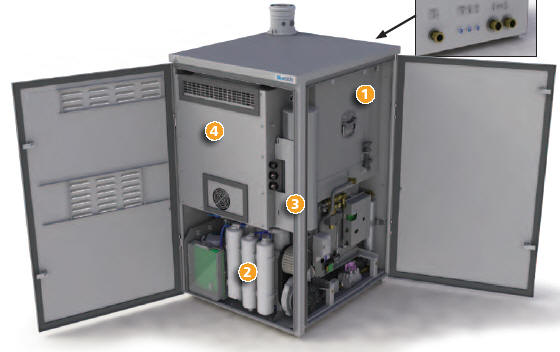
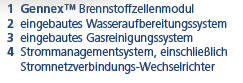
Ceramic Fuel Cells' first field trial units were operated in Australia, New Zealand and Germany from early 2006. In 2007 the company developed its high efficiency Gennex fuel cell module, which is the core of the Company's BlueGen product (first installed with customers in 2010) and integrated mCHP products (developed with appliance partners in Germany, France and the United Kingdom).
Up to 1 May 2012, a total of 189 units have been operated at Ceramic Fuel Cells' facilities in Melbourne and Germany, as well as at customer sites in nine countries. Cumulative operation from all of these systems has now passed one million hours.
The company's products use ceramic fuel cells to turn natural gas into electricity - as well as heat for hot water - for homes, schools, offices and small commercial buildings. Surplus electricity can be sold back to the grid or used in supplementary applications such as charging electric cars. Our products have the highest electrical efficiency of any small scale generating technology in the world, reducing energy bills and cutting carbon emissions.
The company currently has an order book of 619 units made up of 264 integrated mCHP products and 355 BlueGen(R) products.
The number of units installed and operating at customer sites has increased significantly in recent months and is now up to 199. (This number is updated and reported on www.bluegen.net.)
Ceramic Fuel Cells Managing Director Brendan Dow said milestones such as one million hours of operation are important. "These units are not just operating in our labs, but at many customer sites in nine countries around the world," he said. "We continue to optimise the lifetime and reliability of our products, offering customers a real alternative to energy generation, saving them money and dramatically reducing their carbon emissions."
Brendan Dow discusses the Company's current activities in a webcast interview with BRR Media, available at http://www.cfcl.com.au/webcasts.
** BlueGen recently featured on Australian Channel 7's Today Tonight program - http://au.news.yahoo.com/today-tonight/latest/article/-/13501222/power-saving-breakthrough/
ENDS

Thursday, 10 May 2012

The LE-600 48v wind turbine is designed to charge a nominal 48v battery bank


The LE-600 48v wind turbine is designed to charged a nominal 48v battery bank. The way this works is that once the turbine begins to turn, voltage is generated as the turbine speed increases. At this stage, the turbine is off-load and has not yet 'cut-in'. When the LE-600 reaches approximately 290rpm at 3m/s (its designed cut-in speed) the turbine voltage will have increased to level of the battery voltage, in this case 48v nominal. This cut-in speed is by design as the turbine blades need to be rotating fast enough to generate lift before any load is drawn from them. As the turbine speed and voltage continues to increase with windspeed, the batteries 'hold' the turbine voltage down and the turbine instead delivers current to the batteries.

Charging batteries is very simple for the wind turbine. The batteries are effectively a resistance and current is delivered from the turbine and into the batteries following the principles of ohms law.

Using any grid-tie inverter is far more complicated as the simplicity of ohms law is not present.
Instead, the inverter has to be programmed with a MPPT curve which tells the inverter how much power to draw from the turbine judging by the turbines speed. Draw too much power to soon, and the turbine will stall. Draw too little power and the turbine will run very fast and noisily and will not generate much power. The inverter monitors the turbines output voltage and uses that as an analogy for speed. To further complicate the situation, once the turbine is 'on-load' and doing work, its output voltage is no longer proportional to the speed. Thus the MPPT curve that is programmed into the inverter is quite important!

The Windmaster 500 has a voltage range of 25-125 volts in which the MPPT can be programmed. When using a Windmaster 500 with the LE-600, the MPPT curve is programmed between 25-65v.
We have found in our testing, that a LE-600 neither a 48v or 24v are quite right for use with the Windmaster and thus we developed the GT1 variant. In a way you could describe the GT1 variant as a '30v' variant. It puts the voltage characteristics of the turbine in-line with the aerodynamic characteristics of the turbine blades and the electrical characteristics of the Windmaster 500 and the MPPT curve that is programmed into it.

Turbines of different manufacture have different aerodynamic / electrical characteristics and some use 48v turbines with the Windmaster 500. There are a lot of variables and this might be ok with other turbines, but we weren’t quite happy with that and so developed the GT1 variant.

It would be possible to use a 24v or 48v LE-600 with the Windmaster, but the performance would be sub-optimal  and in any case we have developed the GT1 variant especially for the Windmaster 500.

Monday, 30 April 2012

ARIAN SILVER CORPORATION Files San Jose Technical Report Update


TIDMAGQ 
 
Arian Silver Files San Jose Technical Report Update 
FOR:  ARIAN SILVER CORPORATION 
 
TSX VENTURE, AIM, PLUS SYMBOL:  AGQ 
FRANKFURT SYMBOL:  I3A 
 
April 25, 2012 
 
Arian Silver Files San Jose Technical Report Update 
 
LONDON, ENGLAND--(Marketwire - April 25, 2012) - Arian Silver Corporation ("Arian" or the "Company") (TSX VENTURE:AGQ) 
(AIM:AGQ)(PLUS:AGQ)(FRANKFURT:I3A), a silver exploration, development and production company with a focus on projects 
in the silver belt of Mexico, today announced the release of a Mineral Resource Report dated 23 April 2012 and 
entitled "Arian Silver Corporation, Resource Estimate 43-101 Technical Report, San Jose Project, Zacatecas, Mexico" 
prepared by CSA Global (UK) Limited (the "2012 Technical Report") relating to the updated mineral resource estimates 
contained in Arian's press release dated 12 March 2012 entitled "Arian Silver Increases Contained Silver at San Jose 
by 32% to More Than 117 Million Ounces in Updated Mineral Resource Estimate". 
 
The 2012 Technical Report has been filed on SEDAR and can be found by visiting the Company's publicly available 
records at www.sedar.com or on Arian's website at www.ariansilver.com. 
 
About the Company 
 
Arian is a silver exploration and development company and is listed on London's AIM; trades on London's "PLUS" market; 
is listed on Toronto's TSX Venture Exchange and on the Frankfurt Stock Exchange. Arian is active in Mexico, the 
world's largest silver producing country. The Company's main project is the San Jose project in Zacatecas State. Part 
of Arian's forward-looking strategy lies in the envisaged use of large scale mechanized mining techniques over wider 
mineralized structures, which reduces the overall unit operating cost of metals, and to build up NI 43-101 compliant 
resources. 
 
Qualified Person 
 
The "Qualified Persons" (as such term is defined in Canadian National Instrument 43-101) who supervised the 
preparation of the SJ Technical Report, are Mr Galen White, who is an employee and Principal Consultant of independent 
consultants CSA Global (UK) Limited, and Mr Martin King, who is a Geological Consultant to CSA Global (UK) Limited. 
Messrs White and King have reviewed, verified and approved the contents of this release. 
 
Mr. Jim Williams, Eur Ing, Eur Geol, BSc, MSc, D.I.C., FIMMM, the Chief Executive Officer of Arian, is a "Qualified 
Person" as defined in the AIM guidelines of the London Stock Exchange, and a "Qualified Person" as such term is 
defined in Canadian National Instrument 43-101 ("NI 43-101"). This press release has been prepared under Mr. Williams' 
supervision. 
 
 
-30- 
 
FOR FURTHER INFORMATION PLEASE CONTACT: 
 
Arian Silver Corporation 
Berkeley Square House 
Berkeley Square 
London 
W1J 6BD 
England 

UK Coal Annual Report and Accounts 2011


RNS Number : 1945C
UK Coal PLC
27 April 2012
UK COAL PLC
Annual Report and Accounts 2011
For RNS purposes graphs and page numbers have been omitted.
Chairman's statement
Results for 2011
For the first time in four years UK Coal delivered a profitable year, with overall pre-tax profits of GBP58.0m, compared to the loss of GBP124.6m for 2010 and cumulative losses from 2008 to 2010 of GBP269m. This improved performance is in line with our Recovery Plan, with an increase in revenue from improved production, stock reductions and realised sales price, and from our initial steps in addressing our cost base.
Net bank debt fell to GBP55 million at 31 December 2011 against GBP141m in 2010. This reflects the realisation of value from our property portfolio, with sales of GBP67m achieved at prices slightly ahead of book values.
Recovery Plan
In my statement last year I set out an assessment of UK Coal's business performance as I had found it on becoming Chairman in November 2010. Shortly afterwards, we announced the detailed priorities for the first steps of our Recovery Plan, which has delivered a profit in 2011. We have made some significant progress during the year:
i. We were very clear that our highest priority was to improve the safety of our mining operations and made initial good progress. Our All Accident Rate for 2011 improved by around 20%. A fatality in September further accelerated our efforts, through our Critical Safety Review, on the changes that are needed around behaviours and working practices.
ii. Our property business, Harworth Estates, performed well with net receipts from property disposals of GBP65m in the year.
iii. We made substantial progress in addressing high, and unaffordable, workforce costs and the future service cost of the Group's defined benefit pension schemes. Service costs have been halved. Labour agreements reached during the year are expected to hold per capita employment costs broadly at 2010 levels until the end of 2013.
iv. We started work on balancing long term security of sales contracts with more flexibility around market conditions.
v. Good progress was made in improving financial and operational controls across all areas of the business. We continue to fight inefficiency and high costs, although much remains to be done.
vi. We started work on rebuilding the management of the Company with significant new appointments to our mining team in the second half of the year.
vii. At year end, net bank debt, excluding restricted funds, was reduced from GBP141m to GBP55m. Total net debt, excluding restricted funds but including loan prepayments, has reduced from GBP242m to GBP139m.
viii. By the end of 2011 we had completed the re-building of the Board, with the appointment of four new Non-Executive Directors since late 2010. These appointments have contributed a fresh outlook and new determination to the Board.
Current progress
While there were significant achievements made in 2011, difficulties at Daw Mill from late 2011 highlighted how much remains to be done to put the UK Coal mining business on a stable footing.
We highlighted in April last year that the Company once again faced a potential three-month "face gap" at Daw Mill, following the four-month face gap in 2010 which cost the Company the majority of the GBP100m raised in October 2009. Our mining team developed a two-part mitigation strategy to avoid a 2011 face gap.
At the end of 2011, the element of mitigation which relied on extending the 32s face at Daw Mill failed as a result of combined geological, workforce and management problems. Work started in January 2012 on the second part of the mitigation strategy which was to commence the next face early. The ramp-up of this face was very slow, taking three months in Q1 2012.
The high fixed cost structure inherent in our deep mines and a two week cash conversion cycle coupled with poor operational performance has an immediate impact on the Group's financial position. The current structure, whereby all mines are in the same corporate entity, can quickly result in one mine putting the entire Group at risk.
The problem of operational vulnerability is compounded by the level of our pension deficit and debt to customers and banks. The pension deficit, under the principles used by the Trustees to determine future funding, has almost doubled from around GBP250m at the last valuation in 2009 to approximately GBP430m.
As a result, the Company has recently announced its intention to restructure the Group to isolate the operating risk of each deep mine from the Group as a whole and mitigate future financial uncertainty arising from operations at Daw Mill or other mines. It was also announced that a consultation process has begun regarding the early closure of Daw Mill in 2014, subject to the option to retain Daw Mill under a new structure and operating model.
2012 restructuring
Our proposal to parties with an economic interest in UK Coal would entail a more formal separation of mining and property interests, each with an appropriate capital structure. The plan is intended to isolate the operating and financial risk of each deep mine from the Group as a whole and to address the funding and debt structure of the Group.
We have continued constructive discussions with our principal banking partners, Lloyds Banking Group, together with Barclays Bank, the Pension Funds, our customers, the Department for Energy and Climate Change and the Coal Authority. We are in the process of tabling our detailed plan to these parties.
Our intended plan involves a substantial reduction of the pension, and other, liabilities of UK Coal. Under this plan, the Board believes that the value inherent in the mining business can be properly exploited for the benefit of all stakeholders. A minority equity stake in the mining business, together with an interest in the future cash stream from the realisation of the property portfolio, would be offered in consideration for the reduction of pension scheme and, potentially, other stakeholder liabilities.
The Board believes that there is potential value to be realised from our substantial brownfield property portfolio through the development process. It is proposed that the property company would take over the bank debt of the Group and an agreed liability as part of a compromise of the pension scheme. Our proposal is that equity funding, which will be ring fenced to the property business, will need to be raised for the period of time required to pay down bank debt whilst the development process releases this value.
The Board believes that this plan is the only practicable way to create a sustainable structure for the Group. We recognise that this will require significant co-operation and support from all of those with an economic interest in the Group. Without this support there would be a significant risk to the Group, and, in particular, to the continuation of the mining business. We hope to be able to report on the result of our negotiations at our AGM in June.
Outlook
The reliance on coal in the current energy mix continues. During this recent winter, mild as it was, coal generated around half of the electricity needed in the UK. The proposed introduction of the carbon support price may reduce the demand for coal, but coal remains a key factor in keeping energy bills as low as possible.
In the short and medium term, as the UK manages the transition to a cleaner energy future, in a way that also maintains an affordable price for electricity, coal continues to be part of the energy mix. With over 100 years of reserves left in the UK, it is important that we continue to use coal mined in the UK rather than relying solely on imported coal.
We have two immediate over-riding priorities:
i. To operate the business safely and successfully, delivering the continuing targets of our recovery plan and in particular to improve production at Daw Mill where the recovery of 32s face still has to be achieved and the equipment transferred to 33s on a timely basis.
ii. To set out and negotiate, with our very wide range of stakeholders, a new structure for the Group to enable it to continue into the medium and longer term.
UK Coal has made significant progress on achieving the objectives set at the beginning of the year. I believe we now have a realistic and practical solution for taking the Group forward and would like to thank all those at UK Coal who have contributed to this progress.
Jonson Cox
Chairman
27 April 2012
Company Information and AdvisErs