Showing posts with label solar. Show all posts

Wednesday, 30 March 2016

Wind And Solar Education Kits for Schools , Colleges and Universities


We have now introduced installation kits for wind turbines including marine and land based applications. Easy to install and offering energy generation from wind power. Ideal for powering mobile homes, boats and sheds. Click here for wind turbine kits


The Power Education systems are a great introduction to wind and solar power generation. The kits are designed for education facilities in mind and give the users a hands on practical approach to this growing industry. Click here for educational kits

Friday, 2 December 2011

Semi-Flexible Spectra Spectralite 20W Solar PV Panel - £172.75

Semi-Flexible Spectra Spectralite 20W Solar PV Panel - £172.75: "Outstanding Quality Semi-Flexible Solar PV Panel
The Semi-Flexible Spectra Spectralite 5W Solar PV Panel can be walked on with deck shoes and can be flexed by 1cm per 30cm for fixing to curved solid surface such as a coach roof. The Spectra photovoltaic are oustanding quality and ideal for a tough marine or harsh land application."

'via Blog this'

Thursday, 21 July 2011

Solar / Wind Turbine Education Kits


Solar / Wind Turbine Education Kits: "Educational systems aimed as a practicle introduction to solar and wind power generation and monitoring. The power ED (educational) control panel shows the user power generation information with the aim of teaching the basic principles of generating electricity from wind and solar. Ideal for schools, colleges, university and eco educational facilities."

Monday, 16 May 2011

Foreign manufacturers of electric cars in China can own only minority shares and they must surrender intellectual property

Foreign manufacturers of electric cars in China can own only minority shares and they must surrender intellectual property on at least one of what the government considers to be the three key enabling technologies for e-mobility. These are batteries, motors and control electronics. In exchange, foreigners gain access to a market they hope will be large enough to create cash flow that can be repatriated if the dominant partner approves. Unfortunately for them, electric bikes, and, at the other extreme, electric buses and trains consume one fifth of the energy per passenger kilometer of electric cars. Add to this the fact that China can never build enough roads, charging or parking places for cars and it is clear that the domestic car market in China must be treated with caution. That formidable country is actually creating, on the cheap, a huge export business in electromobility.

For those outside China, there is better news, however. Most countries have plenty of space for cars and there is reason to predict a robust business in all forms of electric vehicle, whether or not they are made in China. This is partially because the technology is changing very rapidly, giving an advantage to those doing major research and development. AC motors are often taking over from DC ones. The AC motor's electronic circuitry - a very different skill - is often replacing DC commutator metalwork. Electronic circuitry, including control electronics for EVs, is becoming laminated and even printed to save space, weight and cost and improve reliability. Batteries are going partly from inorganic to organic chemistry and back again in a very different form and here liquid handling giving way to printing and other deposition of solids. That addresses challenges such as improving safety and energy density (range) at the same time. Sion Energy and Planar Energy of the USA, Oxis Energy of the UK, and for key materials, Dow Chemical of the USA are among the ones to watch here, as the West seeks to leapfrog the dominant East Asian Li-ion battery manufacturing.

There is more. A fourth key enabling technology has appeared. It is energy harvesting, converting ambient energy to electricity to charge the traction battery or at least run wireless sensors, lighting and actuators. This reduces weight to increase vehicle range and it increases space and improves safety. Previously, a photovoltaic roof on a car only provided 50 watts or so - certainly of no use in charging batteries. However, the small Asola Automotive Solar Deutschland GmbH silicon roof panel on the Fisker Karma hybrid sports car generates over 100 watts peak. The new bendable and sometimes flexible and conformal Dye Sensitised Solar Cells DSSC work well with low levels and angles of light and with polarised light off windows and water and even with infrared. Put them on the sides, undersides and even insides of electric vehicles and kilowatts are in prospect. New flexible copper indium gallium diselenide CIGS photovoltaics is already seen around complex shapes of aircraft and surface boats, such as those by Grove Boats and Kopf Solarschiff of Germany. The University of Michigan and the ENFICA-FC project in Italy funded by the European Commission are among those shaping solar panels onto unmanned electric aircraft.

Meanwhile, large and small electric vehicles on land and sea are showing the feasibility of electrodynamic energy harvesting generating up to a massive ten kilowatts or more. From the old bicycle dynamo we went to the now well understood technology of regenerative braking - motors of on-road vehicles working in reverse to grab back electricity during braking. Valence Technology of the USA with family yacht maker Beneteau of France has now moved on to do the equivalent thing with ocean going yachts. The propeller is dragged in reverse when the vessel is under sail, thus charging powerful lithium-ion batteries so they operate electrics silently when the craft is moored. Callender Designs of the UK has something similar in its superyachts combined with rigid solar sails.

Further, we now have superyachts scooping water into a hydro turbine when under sail to charge second generation, safer lithium-ion batteries. Indeed, the largest design of Paracas Yachts in Miami is a 48 meter superyacht that can produce enough stored electricity for its refrigeration, air conditioning and other "hotel facilities" for one week just by sailing for an afternoon. Hydro-Kinetic Designs in the USA is now moving such technology into working vessels. These and other craft innovate in many other ways thanks to electric drive systems. For example, the propellers are far more efficient because they are suspended in pods with their electric motors, there being no propeller shaft. Some ships and boats use electrodynamic harvesting in the form of computer controlled kites sweeping an optimal figure of eight to charge the traction batteries.

You can now buy an electric aircraft that soars as a glider to charge the batteries by reversing the propeller and a similar thing seems to be feasible with underwater electric vehicles. Some vehicles erect a wind turbine to charge the battery when they are stationary. However, the most widely applicable powerful energy harvesting is yet another electrodynamic option - the energy harvesting damper or shock absorber. A set on a bus or truck generates a very useful ten kilowatts. Leader here is Levant Power Corporation of the USA which also targets pure electric Autonomous Underwater Vehicles UAVs to benefit from their devices. Some AUVs already combine photovoltaics and wave harvesting. On the other hand, in its owner's 78 meter superyacht, Sauter Carbon Offset Design in Bali has a motion damping system that generates an incredible 100 kW. Here the lithium-ion battery is part of the damping pendulum employed. The humble bike dynamo has come a long way.

The closely linked energy storage is also rapidly evolving beyond batteries. While some concentrate on making third generation highest energy density batteries a safe reality, Elon Musk founder of Tesla Motors has expressed the opinion that supercapacitors (ultracapacitors) are key to future energy storage in electric vehicles, even replacing batteries. Indeed, it is already clear that, with them incorporated in electric bikes and buses to boost battery performance, there is more to come. Developers such as Nanotecture of the UK and OptiXtal of the USA are widening the repertoire to so- called asymmetric electrochemical supercapacitors (supercabatteries) combining the best of batteries and supercapacitors and OptiXtal describes wide area flexible ones that can form part of the skin of an electric vehicle and tiny microdot ones to incorporate in the plethora of wireless sensors and actuators in modern e-mobility. OptiXtal has pioneered the creation of low ESR, ultrathin, and flexible supercapacitors to optimally fill available space.

Multiple energy harvesting is now a key enabling technology for electric vehicles whether they travel on or off-road by land, on or under water or in the air. Just don't tell the Chinese.

All this and more will be aired at the unique electromobility event Electric Vehicles: Land, Sea & Air Europe 2011 in Stuttgart, Germany 28-29 June covering the whole subject for the first time. Most of the above companies will be presenting alongside a large number of other vehicle manufacturers, including Daimler, Tesla, Opel and Tata the largest automotive company in India, and organisations leading the next wave of radically different electric vehicle technology, including start up CHE-EVC of the UK on a very different intelligent Li battery system and Mitsubishi of Japan and Siemens of Germany on a totally new approach to charging systems.

Electric Vehicles: Land, Sea & Air Europe 2011 will include two full days of conference proceedings and an exhibition floor. In addition, there will be technical masterclasses, an awards dinner, and plenty of opportunities for networking. For full details on the event, please visit www.IDTechEx.com/evEurope.

Friday, 15 April 2011

For the UK Which domestic renewables incentive is best?

Adam Mactavish of Cyril Sweett provides a brief review of the incentive schemes for domestic renewables

A few years ago only the most dedicated developers (or those with tough planning requirements to meet) contemplated the use of renewable energy in new housing, while only the greenest of homeowners would consider retrofitting them into their properties. The cost, hassle and risks associated with the technologies were just too high.

A raft of new incentive schemes is rapidly changing attitudes. In fact, demand has been so high, with nearly 200MW (or 150 hectares) of large scale “solar farms” in the planning system, that the government has reduced its support for larger scale solar electric (PV) systems (those above 50kWp). Uptake of PV in the domestic sector has been broadly in line with expectations with about 15,000 small (less than 4kW) registered installations at the end of last year.

The same but different
Two incentive schemes are relevant to the domestic sector: feed-in tariffs (FIT) that support the generation of renewable electricity and the Renewable Heat Incentive (RHI), which focuses on technologies that generate heat. The structure of the schemes is similar, although the funding roots differ, with FITs paid for through utility bills and RHI money coming from government budgets.

From the domestic perspective, the key difference between the schemes is that while FITs are already available you will need to wait until 2012 to be able to claim RHI monies for domestic properties. This is because the RHI is being launched in two phases, the first of which, from 2011, only focuses on larger scale heat installations. In the second phase, from 2012, domestic scale installations will also be eligible for payments. The start of this second phase will coincide with the launch of the Green Deal, meaning that homeowners will be able to undertake both energy efficiency measures and install renewable technologies in a co-ordinated way.

For both schemes, any compliant technologies installed after 15 July 2009 will be eligible for payments, but payments under the RHI will not begin until 2012.

Together, FITs and the RHI provide support for most of the major forms of domestic renewable energy including PV, wind, solar water heating, biomass and ground source heat pumps. One notable omission is the air source heat pump. However, the government has stated it intends to introduce support for this technology for domestic property in the “second phase” of the RHI in 2012.

Some support for the domestic sector is included in the first phase of the RHI. This will take the form of Renewable Heat Premium Payments from a total fund of £15m. The payments will help subsidise the costs of installation in return for information from the households on their experience of using the technology. Details of these payments will be set out in May 2011 with the first payments made in July.

What are they worth?
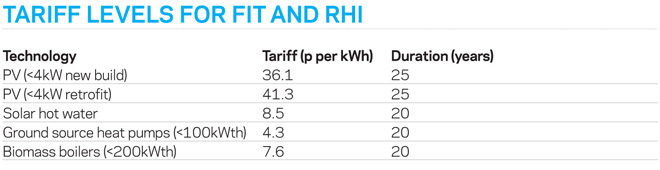
The support offered by FIT and RHI varies significantly between technology types. The tariffs for typical domestic installations are shown in the table below.


Tariffs for the technologies supported by the RHI are set for larger scale use. This is justified on the basis that larger installations will offer the most cost-effective means of generating renewable heat. It is not clear whether additional domestic-scale tariffs will be introduced before the second phase.

Assessing whether these incentives make renewables a sound investment involves consideration of several factors:

Size

For heating technologies, the appropriate system size will vary according to home type, size and energy efficiency level.
For power technologies the system size will be limited by the extent of roof area.
Installation costs

The domestic renewables sector is establishing itself in the UK. However, costs still vary significantly for the same technologies. Careful assessment of different providers and delivery options is important to getting the right level of cost and risk.
Technologies and installers need to be Micro Certification Scheme-approved.
Allowance must be made for the full range of cost items including, for example, fuel storage for biomass and scaffolding and connection costs (for solar hot water or PV).
For retrofit of technologies into existing homes it is important to consider access and integration of the incoming technology with existing systems. For example, a heat pump system will not work well in a poorly insulated property with radiators.
Running costs

All renewable technologies will require servicing and replacement of components. For “non-essential” technologies such as solar hot water and PV the system must remain operational for tariff payments to continue.
Biomass and heat pump systems will require fuels and this must be factored into any assessment. It is likely that the costs of electricity will continue to rise in the future and probably at a faster rate than gas prices.
Tariff levels

Tariff levels are fixed at the year of installation but are subject to inflation.
Tariff levels are subject to periodic reviews and, in the case of FITs, planned degression - reductions in tariff levels to compensate for predicted reductions in technology costs.
Export income and avoided energy costs

A percentage of the power generated by PV systems will be exported to the grid. This is assumed to be 50%. However, in some cases, for example where nobody is at home during the day, the export percentage may be much higher. All power exported to the grid can be sold at 3p per kWh.
Use of energy from PV or solar hot water within the home will reduce the requirement for fuel or power from the grid. This avoided energy cost can be significant, particularly for properties that are off gas where the heating is delivered using oil or electricity.
Warranty

Many technologies will be supplied with reasonable warranties (for example, 25 years for PV panels). However, it is important to consider the organisation providing the warranty and the fallback position should the organisation fail.
Warranties for watertightness or other associated impacts must also be considered. The NHBC has introduced guidance on the criteria they will consider when assessing whether they will provide a warranty for homes with renewable technologies.
The table attached summarises costs, benefits and returns offered by different systems in a typical new (Part L 2010) end of terrace house (about 75m2). Analysis is based on survey of technology costs by Cyril Sweett for the Zero Carbon Hub.

Conclusion
It is clear that for housing the FIT provides a more valuable incentive than the RHI, partly because the RHI tariff levels are set for maximum system sizes that are larger than would be used in homes. A further factor reducing the cost effectiveness of the RHI in new homes is their low heat demand compared with existing housing and industrial uses. While incentives for using PV remain strong, RHI tariffs for domestic scale technologies will need to be higher if they are to prompt many installations.

As the second phase of the scheme will coincide with the Green Deal we should hope that the opportunity to support investment in energy efficiency and low-carbon heat is maximised.

From building.co.uk

Tuesday, 5 April 2011

Mastervolt Soladin 600 Grid-Tie Inverter including PC link


Mastervolt Soladin 600 Grid-Tie Inverter including PC link

Designed for solar panels up to 600 watts. Easy installation

Buy At www.orionairsales.com

The Soladin 600 is a grid connected inverter for connecting solar panels (or wind turbines) to your existing electrical system. The successful Soladin 600 Solar inverter, some 6000 of which have already been sold by Mastervolt for small 4-6 module based grid connected solar systems. The Soladin 600 offers a simple solution when connecting solar panels to your household mains supply. With it's light weight and compact size, the Soladin 600 can be installed inside existing meter cupboards or in outbuildings (but it is not suitable for outdoors). Connection to the input of the inverter is provided by 2 dedicated DC power plugs. The output should be connected in accordance with the electrical requirements for the country of installation.

The Soladin 600 is equipped with 230V and DC connections and designed for mounting inside homes. The solar inverter is fitted with two MultiContact DC terminals for easy plug&play installation. All Soladin’s are fitted with a communication port for remote monitoring and an advanced yield indicator at the front. The wide input range makes them a flexible system solution.This inverter is supplied for UK use and comes complete with DC input plugs, PC-link connection and Monitoring/Logging software. In "Hybrid" systems (those involving both wind turbines and solar PV), use the standard Soladin 600 inverter, keeping the installation simple and very neat.

The Mastervolt Soladin 600 inverter has a power rating of 600 Watt continuous with an input voltage window between 40-125V DC.

Product Key Feature's

600Wp capabilty
Excellent price/performance ratio
Exclusive lightguide power indicator
G83 approved for use in the United Kingdom
Suitable for most types of wind turbines
Free downloadable PC monitoring software
5-year warranty
Wide input range makes for a flexible system solution
Quick and easy install with mounting bracket (included)
2 dedicated DC power plugs
input voltage window between 40-125V DC
mini string inverter

Technical Data

Model Soladin 600

Article number
Operating temperature
- 20 to 50 °C (full power up to 40 ° C)
Storage temperature
- 20 ° C to 70 ° C
Relative humidity
Max. 95% non-condensing
Electronics have anti-moisture coating
Protection degree
IP 23 (for indoor use)
Safety class
Class II double insulated
Galvanic isolation
Class II HF transformer
Enclosure
UL 5V fire retardant ABS/PC
Mounting
Wall mounting, bracket included
Dimensions
92 x 72x 225 mm
Weight
2 kg
Warranty
5 years


Input

Nominal power
600 Wdc
Startup power
1 Wdc
Operating voltage range
35 – 150 Vdc
Full power voltage range
65 – 125 Vdc
Max. current
8 A
Max. short circuit current
12 A
Connectors
MultiContact 4 mm type

Multicontact “pigtail” adapters included


Parallelling
Multiple units can be operated in parallel to increase output power


Output

Nominal power
600 Wac
Grid Voltage
230 V (185 – 264 V programmable)
Frequency
50 Hz (48 – 52 Hz programmable)
Cos Phi
0.99
Standby power consumption
<0,05 Wac
Max. efficiency
93%
Connection
1,8 meter of AC wire

Thursday, 24 February 2011

Solar panel has world's highest energy conversion efficiency rate of 21.6 percent

A manufacturer of what is believed to be the world's most efficient solar units announced on February 1 that the cells have achieved MCS accreditation and are now ready for use in the UK.

SANYO Component Europe GmbH (SANYO) produces the HIT series of photovoltaic cells, including the N 220SE10 which, to date, has the world's highest energy conversion efficiency rate of 21.6 percent.

On February 1 the company announced that the HIT cells had passed MCS accreditation. MCS accreditation is bestowed upon companies by the independent Microgeneration Certification Scheme, which certifies small scale or 'mircogeneration' technologies that are used to produce heat of electricity from renewable resources.

Though the HIT Series of cells are already commercially available throughout mainland Europe, MCS accreditation is required before products can be released into the UK market.

For consumers the MCS accreditation essentially means that consumers can use the HIT cells under the Feed In Tariff (FIT) scheme - a Europe-wide financial incentive rewarding those who install power generating renewable energy devices connected to the grid.

This is of benefit to consumers as the high efficiency rate allows more power to be generated using fewer cells and also means that less roof space is required to generate solar power- which increases the opportunities for renewable energy generation for those where space is an issue. The 'N' series of HIT modules will be commercially available from March 2011.

Other renewable energy companies from around the world will be showcasing the latest in renewable and energy efficient technologies at a series of upcoming exhibitions including), EXPO Solar in Goyang, South Korea (February 16-18), the Renewable Energy Expo in Lyon, France (February15-18) and Eco Build in London (March 1-3).

Eco Build attracts over 1,300 exhibitors and 41,000 visitors from around the globe and is used by companies as a launchpad for their new products. At Eco Build 2011 numerous photovoltaic companies including Emmvee, the Ideal Group and Mitsubishi plan to launch their latest innovations in the field of solar power.

Wednesday, 23 February 2011

Mitsubishi Electric Corp. has installed an 85 kW photovoltaic system on the roof of Makita Corp.'s main factory in Takamatsu City, Japan

Mitsubishi Electric Corp. has installed an 85 kW photovoltaic system on the roof of Makita Corp.'s main factory in Takamatsu City, Japan.

The PV system, which is the first for Makita, will begin generating electricity later this month, according to Mitsubishi Electric. Electricity generated by a total of 448 PV modules installed over a surface area of 700 square meters will cover approximately 3% of the manufacturing, air conditioning and lighting requirements at Makita's marine diesel engine factory.

SOURCE: Mitsubishi Electric